Search This Blog

Friday, June 28, 2013

A Cow Head 25th

Day one of marinading
          I recently found myself in a conversation with a few people about birthdays and what constitutes a memorable birthday celebration. As I sat there thinking about the question I tried to reflect on as many individuals’ birthdays as I could, but found myself unable to remember anything before the age of 18. I guess that makes sense given that it is always easier to remember things that occurred more recently, but it got me thinking about my birthdays especially since mine was coming up. Turning 25 is not exactly a milestone birthday other than I think I can now rent a car in America, which isn’t my idea of exciting. The more I thought about it the more resolute I was in my decision to do something memorable for the big 25. Considering 24 was spent in the middle of a Peace Corps sponsored workshop, I felt that I hadn’t yet partaken in a Paraguayan style celebration of me. That being said I still didn’t have much of an idea of what I was going to do, or who I was going to include until inspiration struck me like a sack or bricks or in this case bones.
                                  I was having lunch a few months ago at Julio’s, my community contact and host father in O’Leary, during Paraguayan Labor Day. Julio’s brother, Jorge, operates a brick making operation in his backyard. In celebration of that important day he and his buddies were busy participating in; well let’s just say imbibing the copious amounts of the local nectar. I noticed that between gulps they were picking at an oddly shaped piece of meat wrapped in tin foil. I asked Julio what they were eating, and he quickly told me that it was a cow head. They promptly served me some tongue after my inquiry, and have to admit it wasn’t as bad as I thought it would be. Having been brought up in a time and place where organs and other less desirable cuts of beef are not consumed, I was intrigued at the prospect of grilling a cow head for my birthday. I thought when else would this even be an option let alone delicacy? I decided right then and there that was what we were going to do. I’ll concede that living in Paraguay, or any country for that matter, makes celebrating a birthday memorable, but feasting on the head of a beautiful behemoth bovine was exactly the kind of bang I was looking for.
The turn
                                  I asked Julio if they were expensive and if he knew where we could get one? He immediately said that they only cost 35,000 Gs. (roughly $8.00), and that he knew a guy that would sell one at a good price. I am not sure why I was so excited at the prospect of eating the head or a large animal. If head was such a treat why does nobody eat it aside from the obvious? That all didn’t matter what did matter was how they hell were we going to prepare and serve it?
Fresh off the grill
                                  I was eager to get peoples opinions about how to cook and marinade the cow head. Julio told me that the best way to do it is to put it in a bath or vinegar, garlic, pepper, seasoned salt, and cumin. Not having any basis to disagree I said that sounded great, and in the weeks leading up to my birthday celebration this past Saturday I was sure to get a bevy of opinions from my friends around the community. Given that Paraguayan cuisine isn’t exactly world renown, I was surprised by the mixed reactions I got from people when I told them about my plan. Some people loved the idea while others looked at me in disgust. The diverging opinions sort of baffled me at first, but the more people I asked the clearer the reasons for the differing opinions were. For anyone who has spent some time with their grandparents growing up can attest, their food preferences can at times leave a young child running for the bathroom. Now I’m not talking about gross vegetables or leftover whatever, but more along the lines of internal organs. I have vivid memories of my grandmother and I going out to eat at a buffet style family restaurant where fare had many dishes that were geared towards the more elderly clientele. I always remember having grandma ask me to bring her a plate of chicken livers to which she would eat at a maddeningly slow pace while waited often times impatiently by engorging on enough soft serve ice cream to me as sick as I perceived chicken livers would make me if I ate them. The chicken livers were easily her favorite dish and would constantly rag me about not trying them. The older I got the more I relented, but I never acquired a taste for them and probably never will.
Digging in
                                  My desire to not eat chicken livers with my grandma is similar to my younger Paraguayan friends desire to not eat cow head. I noticed, however, that socioeconomic status had lot to do with people’s choices of meat and taste preferences. I guess this is pretty obvious because the less desirable cuts of meats are not only cheaper, but also abundant. Many families who have animals sell the prime cuts to supermarkets in the cities or towns and either keep the parts like the stomach, liver, or feet for themselves or to sell in their neighborhood. I notice this occurring in the supermarkets in O’Leary. From time to time there will be a display of a pig or cow head hanging on a sinister looking meat hook in the display case of the meat counter, but for the most part the most prominently displayed meats are shown in front with less desirable hidden in meat lockers behind the counter. It seems as though the supermarkets only display the expensive cuts for the obvious reason that they cost more to buy. Seeing something in front of your face underneath a sign that says special offer might change the mind of the shopper who originally went in to buy cow ankles or some other marginal cut. I have said in other entries that Paraguay is in many ways reminiscent of 1920-1950s America and the butcher shop and the cuts of meat people buy directly support that theory. As the country develops there is more money available to buy choice cuts of meat and more demand. As the demand goes up so must the supply that in turns drives down the demand for cheaper part of meat. It is basic economics, but unlike my upbringing in a time where all I knew were the best cuts of meat in Paraguay, I see the traditional meals and customs that come from the other cuts that have long since left most Americans perceptions of what is edible. Additionally, the number of butcher and butcher sops in communities across America plummeted as supermarkets became abundant and could offer the same meats for less cost. That has not yet happened in Paraguay. The local butcher shops still exist in rural areas and still sell what I’ll call more traditional options.
Playing with the jaw to avoid eating more
                                  My 11-year-old host brother Mathias says his favorite food is breaded and fried cow stomach. Some other traditional dishes that are often served in the rural areas included a soup made of internal organs called caldo ava, what my close neighbor and fellow volunteer calls cow ankle soup, and whenever possible whatever wild animal you happen to shoot when it stupidly wondered onto your property. Even though it is technically illegal, many people hunt and eat wild animals like alligator, carpincho, and opossum. I was recently served a big chunk of what turned out to opossum while eating over at Julio’s house. It had been rooting around the chicken coop in the wee hours of the morning and by the afternoon was the steaming chunk of grill seared meat in front of me. I initially thought it was pork, but my taste buds would not be fooled as I chomped down the first bite of chewy white meat. I did not like it, and took a dictionary for me to figure out what it was. Julio now tells the story that I stopped eating it as soon as I figured out what it was, but neglect to mention that we had eaten our body weight in food before it was ever placed on my plate. I am glad I did it, but probably wouldn’t be grilling the rodent I killed that morning had I been in that particular situation.
Our first ever bite
                                  For the most part, however, my time as a Peace Corps Volunteer has not been defined by weird foods or their subsequent food traditions. Sure I have a few stories, but they more often than not involve me trying something I have had a million times in a way that is only slightly different than the time I had it before and convincing the cook that it was the best version of it I ever had. In spite of all my younger Paraguayan friends telling me not to get cow head, I couldn’t personally think of a better thing to eat on my birthday. Even my close friend Claudio who is about turn 18 had never tried it, which I thought was incredibly given that his dad raved about how delicious it was suppose to be. It makes sense, though, because Claudio’s family is what would classify as middle class for rural Paraguay. They own a store, a motorcycle repair shop, and Claudio now owns a computer repair business in the center of O’Leary. Meat is very much a symbol and I have noticed during my time here that whenever I go over to a family’s house I am always given the biggest and best looking pieces of that is available. People will apologize if we are eating beans or some other non-meat dish because those foods are poor people foods and reminiscent of many people’s childhood when there was much less to eat. So in some way I felt as though the purchase of a cow head for my birthday was a celebration of my personal appreciation for the traditional festive foods of Paraguay.
                            
Leftovers
   It took 4 hours on the grill to cook the cow head after 24 hours of marinating, and to be perfectly honest it looked pretty much the same before it went on the grill as it did afterwards. As I helped Julio lift the cow head from the grill to the table where I was standing with many volunteer and Paraguayan friends I was not exactly salivating at the prospect of eating what was underneath After staring at the smoldering tin foil wrapped head for about 2-minutes I have to admit I was perplexed as to how we were going to eat it. Then with a clang Iris, my host mother, dropped about 15 forks on the table and said lets eat. I’ll now rank my top 5 favorite parts of the cow head, but first I feel that it is prudent to mention that none of it really tasted that good.

1. Back of the head meat
2. Snout
3. Cheek
4. Tongue
5. Brain
Post eye reaction
                                  Some of my braver friends ate the eye, but I was too thrown off by the prospect, and the brain I had just eaten, to give it a shot. The fact that they both woofed it down with minimal flinching after tons of ribbing from the peanut gallery telling them how they were going to vomit was admirable. To say that I left the table satisfied to me means two things. First I did eat enough to feel full. There is a surprising amount of meat on the head, but mostly it was because of my fear of getting nausea by over eating that told my stomach it was satisfied. Second, I couldn’t have imagined a more enjoyable birthday meal for sake of memories. It’ll surely be hard to forget that cold night in Paraguay where I ate my first cow head to celebrate 25 years of existence. Now I can say with confidence that if that is not what makes a birthday special I don’t know what is.

Tuesday, June 4, 2013

Measuring Environmental Impact


           If you are an avid reader of my ramblings, which I am sure most of you are, you have probably picked up on my tendencies to write about the environment both on large and small scales. Recently, I have been thinking a lot about carbon footprints, my individual environmental impacts, and how mine have changed since I moved to Paraguay a year and a half ago. Anyone can calculate his or her carbon footprint online for free if you are so inclined. Provided you have the necessary information to fill in the questions it can take as little as 10-minutes. Having completed carbon footprint tests at several junctures during academic career in high school and college I had come to the conclusion that no matter how sustainably you live your life most Americans have a pretty large footprint. Being able to develop a conscience about reducing ones carbon footprint is a difficult task, but is seemingly becoming more and more important in the American mainstream. Dozens of websites, magazines, and newspapers advertise how one can make their lives greener and reduce their carbon footprint. Reading about all these ways to save energy and reduce individuals carbon emissions in America got me thinking a lot about Paraguay and individuals carbon footprints here. After I took a look at several websites series of questions raging from energy consumption to transportation frequency, I came to the conclusion that it would be next impossible for me to effectively measure my impact here in Paraguay.

            For starters, my lifestyle here is very different than it was in the States. Many of those reasons are seemingly obvious, but the more I thought about them the more I realized how diverging my lifestyle actually is. I don't drive a car, when I travel I do so on public transportation, I consume more food that is grown locally because of Paraguay's economy is shaped, and all my electricity is pirated and produced hydroelectrically. I get my water from a well that, when I have it functioning, an electric pump propels into a water tank over my house. When I don't have the pump working, I flush my toilet, bath, and wash dishes the old fashion way by filling up buckets of well water by hand. The materials used to build my house are as follows: wood, metal roofing, nails, glass windows, metal bars protecting the windows, bricks, cement, and that's about it. My house has no insulation, no carpet, no air ducts, nor a sophisticated plumping system. Even in the nicer houses in the area, relatively speaking, there are not many differences in lifestyles. It is rare to see an air-conditioning unit because they are expensive and drive up the costs of electricity. Winter is short and often only cold for a part of a day eliminating the need for a heater. I find myself wondering if I am making conscience decisions to live "greener" here or am now a product of the circumstances surrounding my life?
            When I was in America I felt, over time, more conscience about the environment and how I could reduce my carbon footprint and live greener as I was growing up. Back home that included things like unplugging appliances, buying certain products, or recycling. Here those choices aren't as easy, but people live more sustainably. Granted Paraguay is a developing country, and within the wealthiest areas of the country there are many people who live more like an average American. For the vast majority of the population, however, people are doing a much better job of being green based on the definitions and indicators of your average carbon footprint test that is sponsored by some American institution or non-profit. Then again here in Paraguay the choices people make are less often predicated on environmental impact and aren't the socially conscience choices, but rather they ones will allow them to become more socially mobile.
            A good example is flight to urban areas. This is a trend seen in countless countries for reasons that range from inability to make a living off the land to better job prospects in the cities. In Paraguay, this phenomenon is similar to other larger countries like Brazil or China in that young people are flocking to the cities in droves to find work to help support their families, but uniquely different for number of reasons. Paraguay's economy is dominated by agricultural commodities particularly soybeans and corn. Most Paraguayans grew up farming, still farm, or at least own land somewhere that is still used for food production. Seemingly everyone knows how to grow food and maintain a field. A distinct part of rural communities identities are the cooperative nature of the families. None of us have much, but we live and work together is how the relationships come off to me. That identity is in changing due to the rapid population growth and limited opportunities to continue the traditional livelihoods. Many farmers, in a similar fashion to what happened in America beginning in the 1970s, have sold, leased, or lost their land to larger landholders who have the capital to absorb smaller farms. Young people are more and more drawn to the idea of moving to a city, finding a more white-collar job, and working the 40-hour workweek to attain a better standard of living. That standard is more and more measured by the ability to obtain things like television, nice phones, or air-conditioning. The countryside is progressively becoming a shell of its former self with a huge percentage of the population being older people still working the land, and their grandchildren. The parents have increasingly left the small rural communities in search of job and educational opportunities in the cities leaving the responsibility of child caring to grandparents. It is almost like they want the culture of the rural community with the commodities attainable from life in the city. None of this is uncommon with regards to development, but it begs to question whether environmental consciousness questions evolves as a country develops, and its economy shifts?
            Carbon footprint tests, environmental impact assessments, or whatever measure used to determine health of an environment have inherent biases. Paraguay is poor country that for the first half of the 20th century had most of its people living off the land. That lifestyle caused minimal damage to their environment, but also meant that there was virtually no enforceable legislation or services from its government because of how poor and isolated communities were. As its economy entered world markets in the 1960s, rapid deforestation took place to meet the demands for wood that developed countries were now not cutting down within there own boarders. The results of rapid developments effects on the environment and the consequences were being seen in places like America, but had not yet been witnessed in a country like Paraguay. The same story goes for industrial agriculture. It brings a lot of money to the country, but also brings causes land degradation and pollution to run rampant making it harder to live in the traditional fashion most people are accustomed to. It also forces those young people to leave the rural area for the urban in search of jobs to support their families. All the while families are more and more exposed and influenced by the resulting trends of a more developed economy. Those trends include changes in diet that lead to high-blood pressure and diabetes, a loss of vocational skills, and the slow degradation of small communities.
Itaipu Hydroelectric Dam
            This trend leads people to make their livelihoods through practices that the developed world find detestable like rooting through garbage to find valuable metals to name one example. There is no question in a carbon footprint test that measures amount and kind of garbage an individual burned. They don't ask how many liters of pesticides you spray on your land, and they don't inquire about shifting diets resulting from less consumption of locally grown foods into industrial food chains. My purpose in writing this was at first to do a personal assessment of my environmental impacts from when I was in America to now, but realized that I couldn't do it because I couldn't effectively include aspects of my life here to the formula provided in the tests. If someone breaks a florescent light bulb on the ground near my house I have no idea how much mercury I am now exposed to. When the dump one kilometer down the road is lit on fire to prevent garbage from blowing on someone’s land I have not the slightest clue if the wind is blowing in my direction and the impact that has on me especially if I put trash in a trash can that ended up at the dump that is now on fire. Without a doubt my carbon footprint here is way less than it would be in the states. I bike everywhere, only take buses about once or twice a week on average, I have a garden, I use a well, my power comes from a hydroelectric source, and my house is as simple as can be.
            Paraguayans care about there environment in same way that Americans do, but where they are in terms of development is more along the lines of where America was after WWII and into the 1950s-60s when companies were highly polluting and environmental degradation was at its worse. As a result Paraguay has some of the most modern and innovative environmental laws in its constitution, but the forces of development and progress impede the ability to enforce those laws effectively. Subsequently it can appear as if Paraguayans don't care about there environment when reality their decision making is a result of circumstances. It was easy for me to recycle cans, bottles, papers, and plastics growing up when all I had to do was throw it in a green container provided by the city. It is not easy to do that when the town I currently live in barely has enough money to collect garbage in the center of the town to dump in an open pit landfill on the outskirts. I feel that it is easy for my generation to scoff at those developing countries that have widespread environmental degradation that is getting worse by the day, but we weren’t around when America reached the point where those mentalities began to change making it easier to adopt a more socially conscience approach.
            I recognize that a number of different factors contribute an individual's, community's, or country's environmental awareness. People are products of the times, and there is never a perfect model in comparing differing societies relationship with there environment, but if one considers where America came from not long that long ago I bet that it would be very reminiscent to what Paraguay looks like today. A history teach in school once said to me in the middle ages if you took a rural farmer in time machine and set the dial to 100 years in the future their decedents would probably be doing the same thing in the same place speaking essentially the same language. If you took you great grandmother and did the same thing they likely wouldn't be able to function because of all the changes. This applies to environmental consciousness in the same way it applies to other aspects of life like work, education, and culture.
             My goals for this entry were to do a comparison of my environmental impacts here and back home. I quickly found out however, that it was more difficult than I initially thought. Societies are constantly changing with the times. America seems to shifting back towards many of those traditional values such as growing ones own food, getting deeply involved in communities, and slowly realizing that relationships are more important that commodities. It is a slow process that takes generations. Will Paraguay follow that trend or will change global attitudes shift the direction of this countries development completely? Obviously I have no idea, but it will surely be interesting to see what happens.

Thursday, May 16, 2013

Bus Party


Road Map
            Getting from place to place in Paraguay is never easy. Given that Paraguay only has an estimated 15.2% of all its roads paved, according to The World Bank, it is no wonder that getting around can be difficult. The vast majority of paved roads are concentrated in the major cities, and important highways connecting said cities. It is therefore not surprising that buses are the most common form of long distance transportation for most people. Many of roads in most places are either cobbled or dirt. Even in some of the larger towns that have highways running through them it will likely that they will only sport one or two paved roads.  It isn't very common at all to have the whole city paved. In O'Leary, there are only 2 paved roads, aside from the highway that runs through the center of town, that extend no more than 100 meters each. Despite the lack of paced roads I consider myself to be one of the luckier volunteers because I live within 2 KM of that major highway that allows me to avoid long distances on bumpy dirt roads. The difficulties, however, stem more from Peace Corps rule that none of the volunteers are allowed to ride motorcycles. That means that we are forced to ride our bikes, if they have not been destroyed on a recent ride on the aforementioned roads, or on foot. Within the last decade the amount of motorcycle usage has grown exponentially giving families better access to the limited paved roadways. This has slowly eliminated the infrequent buses that were once the only method of transportation outside of beasts of burden. As a result motor vehicle accidents, mostly motorcycles, are the number one cause of death amongst young Paraguayans at a rate that is growing about 100% annually.
            As for me, my lack of affluence and my strict moral code against breaking the rules has allowed me to experience cover extreme distances on a wide variety of buses, as well as develop close relationships with a number of ticket vendors, and bus operators. The following is my assessment of each company and my experiences on them. The focus will be on those companies and people that drive on a daily bases through O'Leary and the surrounding area. First, however, it’s important to understand the general classifications of buses and bus operators in the area.
            Given O'Leary proximity to Cuidad del Este (Paraguay's second largest city) along the major highway that connects it to Asuncion (Paraguay's Capital and largest city) we see several types of bus companies:

1. International Buses: These are usually double decker luxury buses that are headed towards Brazil or Argentina.

2. Long distance domestic: Buses that range from double decker to wooden box on wheels held together using cheap metal wire.

3. Local/Regional: Small buses that look like an airport shuttle, but usually less nice.

            For each company there is a story behind my perceptions of their business practices. For each company I will discuss my biased view of the buses, the guys selling the tickets, and anecdotes that I have from these experiences. First, However, I would like to illustrate a few commonalities that most of the companies share:

1. All the ticket vendors in O'Leary are men who absolutely love asking me about my multiple girlfriends.

This is a very common thing for men to do in any culture and circumstances around other men, but for reasons unknown by yours truly the banter is taken to new heights with the men the volunteers in O'Leary refer to as the Bus Stop Hustlers. Without skipping a beat I always asked upon meandering up to the bus stop, in Guarani, "Where are you going?" followed by my destination. I am then asked, after it is assumed that wherever I am going the only reason I am heading there is to visit a woman, prompting them to ask, "What are the women saying?" to which I reply, "Lots of stuff." Lastly, I am questioned about specific details,  "How many girlfriends you have now?" to which I reply "too many to count", which leaves them roaring in laughter. These interactions likely come off as strange, but that the way it is. None of it is true, but being a friend who banters back and forth with the hustlers, who makes meager commissions selling tickets, is probably better for my wallet.

2. Nobody really knows when the bus is going to arrive, but it will always be "in a second."

3. If someone guarantees you a seat it decreases your odds of getting one.

4. If you ever buy a ticket before a bus arrives you can bet that another bus headed to the same place will come before it.

5. Sacrificing quality of a bus for price will make your trip last at least an hour longer.

6. If it is raining, all bets are off.

7. Every driver goes way over the speed limits and swerves through traffic like he is in the middle of a stock car race, but instead of a racetrack it is a 2-lane highway.

8. The only reason a bus doesn't go way too fast is because its engine cannot handle the marc 5 speeds nor insane maneuvering.

9. There is always a chance that your bus will break down.

10. Some terribly dubbed over bootleg action movie, or polka music will be playing but is almost always impossible to hear over the sounds of the bus constantly accelerating and breaking.

11. All buses have one guy driving, and one guy who collects the tickets/money and off loads baggage.

12. All bus drivers are fat

13 Tereré or maté is always consumed while driving even though that is illegal to do in Paraguay.

I'll now describe the companies that I most often see or patron:


NSA: The abbreviation is for "Nuestra Señora de Asunción." Translated it means Our Lady of Ascension. It is most definitely one of, it not the, nicest bus companies in the country. Their routes go all over Paraguay and into Argentina, and are always double decker buses with air-conditioning. The problem with NSA is that because of its status as one of the nicest bus companies it is not uncommon for them to overcharge to 50,000 Gs. ($12.50) ticket to Asunción, but that isn't the most annoying part by far. If you want to ride an NSA you have to find a ticket vendor that will sell you passage before getting on. Why this is annoying is because if you are not in big city or town you cannot hop on their bus if it is going past. On numerous occasions I have been waiting for a long time, notice a bus a distance, flag it down, only for it to stop and deny me entrance because I didn't have a pre-paid ticket.
            These interactions always leave me furious especially because many of the places where I am catching a bus don't have a vendors who won't rip you off by overcharging or have a vendor at all. To date, I have yet to ride an NSA because of my resentment towards their policy of not me picking me up if I don't have a ticket. I'll concede that in most situations I could get a ticket that would not only guarantee me a seat, but also speedy transport, but a man has to have a code and that policy has left me high dry on one too many occasions. Their only saving grace is that the guy who does sell their tickets in O'Leary is one of my favorite bus stop hustlers who is always joking around with me, and lives in my neighborhood.

NASA: To be honest, I have only ridden an NASA twice and the only thing that you could think to relate it to the NASA we are all familiar with is the engine sounds like a space shuttle taking off when it accelerates past 20 kmph. The logo of NASA is remarkably similar to NSA. I suspect because they are secretly the same company, but it could be a straight up copy to save time thinking up different lettering for the logo. The first time I rode one of their buses it was so decrepit that I felt as though I needed a tetanus booster upon entering. The driver dodged traffic less recklessly, but still more dangerously than I was used to on the nicer bus lines. That class of NASA I like to refer to as the 1960s express because that is probably when they were being used in Brazil, and only recently came to Paraguay. Recently NASA has stepped its game up with very nice buses that rival some of the nicer companies, but there is absolutely no middle ground with the quality of the bus. Your choices are either going to be a luxury penthouse version, or a cardboard box on wheels.

Crucero del Este: Is easily my favorite company. Aside from the few times they have ripped me off they have been consistently fair with their prices, and are typically the friendliest. My only personal beef with Crucero is the hustler that sells the tickets at the bus stop in O'Leary is easily the creepiest gut out of the bunch. He is about 25, unmarried, and a hound. On several occasions I have seen him on a motorcycle sloshed off of caña (the cane alcohol sold everywhere). He always asks me about my "girlfriends, and then proceeds to mention the inappropriate ages of the ones he is currently seeing. At times I think he is joking, but at times I don't. He also barely speaks Spanish, so it is always an adventure dealing with him.

Expresso Guarani: Was my favorite company for the longest time. They never stop in the middle of nowhere to pick up random passengers every 20 feet, rip you off, and they are often the nicest looking buses. That being said not too long ago, I was on one of these buses headed back home after a long weekend in Asunción.
Waiting for repairs for the second time
            There were four of us traveling together, so figured we might as well take the nice bus to avoid a prolonged trip. That is precisely when things started to go wrong. For starters, we were lied to about the time of departure, it was scorching hot outside and the bus's air-conditioning wasn't working. The whole point of riding these buses is for the air conditioning especially because the windows don't open. After 4 hours of travel the cabin began to smell like gasoline. That prompted the first attempt to fix the bus, which I am sure was shoddily done, because it broke again 20-minutes later on the other side of the town we were passing through. As we were waiting for it to be fixed again a noticeable storm was brewing and I still had to walk 2 KM back to my house. Robert, the volunteer who lives in the center of O'Leary, and I paid more money to catch the next bus that came by barely making it home before the storm. I have not ridden n Expresso Guarani since.

What you hope you'll get
San Luis: Bar none the most unpleasant bus company of the bunch. Not only are they pathological liars with regards to everything from price, time of arrival, and seat availability, but also express the most indifference in terms customer satisfaction. It is almost like they go out of their way to make you uncomfortable. What I mean by that is they will do anything to make a sale, and once they do that’s it. There is no concern for safety, nor is there so much as a thank you for riding with us. The buses themselves have broadest range of models of any company ranging from spaceship to the iron oxide express.


What you end up getting more often
            The only real guarantee is that you no idea what kind of bus you are going to get when one pulls up to the bus stop, but more likely than not your trip will be a disappointing one. I will admit that I hear the reason for their unpleasantness has to do with a company policy that requires them to do their runs in a certain amount of time. If you don't meet quotas and arrival time then you get docked pay or fired. That mentality trickles down to the guys selling the tickets who will say anything to get on board. I often times lie about where I am going or wait off a distance so I can see the bus coming down the road before I commit to a company. I do this because I know the two guys selling San Luis tickets will be on me immediately the second I make eye contact. The funniest part about the San Luis vendors is that one of them is a 15-year-old kid with blonde hair. The story goes he used to hang around the bus stop for years growing up learning the art of the hustle. When he was 13 he got a job, and has been doing it ever since. I heard that he goes to school at night, but I haven't heard of a middle school that has night classes in the area. Given the moral proclivity of the rest hustlers I get the impression that this kid might be getting the wrong kind of education. To get better idea of the risk you take when riding on a San Luis, check out this recent article from a local newspaper: http://noticias.campo9news.com.py/nd.php?id=36972

Mainumby: Is the opposite of San Luis in almost every single way, and is the only bus company that is more likely to undercharge than over charge. The Mainumby, hummingbird in Guarani, is a local company that runs the last 87 KM heading towards Cuidad del Este. There is only 1 bus in the fleet that is nice looking on the outside. The rest are mini-school buses tastefully painted in earth-toned colors in abstract formations on the outside. The inside is always a party with tons of stuffed animals, religious relics, hand-woven lace decorations of all colors. The real reason I call it a party is because often times they sport a karaoke screen blasting 1980s pop music or polka. The By, pronounced boo in English, is the most commonly used bus for people transporting goods to Cuidad del Este, so in addition to being friendly it is not uncommon to find an onion or an orange underneath the seats. They stop with a higher degree of frequency, but the time differences in arrival are negligible. The guy who collects the money always allows you get settled in before he comes pestering you for your money. Really the only downsides are there might be a bit of animal blood or parts on the floor and the seats are so close together that only a 5'5 person or under can comfortably sit, but who cares the personality of the bus itself makes it worth it.

Guareña: Is based in the city of Villarrica about 3 hours from O'Leary. I really don't have much to say with regards to the service or their buses in particular. As far as I'm concerned they are your average company with some nice buses, but mostly of the not nice variety. My disdain for them stems from a phenomenon that has nothing to do with bus company management. That phenomenon is known as the crowded bus paradox. Everyone knows that certain times of year and certain days are not conducive to traveling. That is not what I am talking about. The amount of random holidays or patron saint days in Paraguay seem to exceed days that aren't holidays. What I mean by this is that I could be leaving O'Leary on some random day of the week, but that day happens to be the patron saint of the town of Villarrica, or a particular national holiday that is celebrated more intensely there than elsewhere. 
       O'Leary for example has a special parade on June 12th to commemorate the Chaco War Armistice, but doesn't do anything for independence day even though both are national holidays. You add certain patron saint days to the mix and what you got is a whole series of days that might lead to you standing on a bus for the entirety of your trip. If you thought I was building to something you were right. On June 17, 2012 I was on a Guareña headed to Villarrica on a bus that was so crowded I could barely fit in the drivers cabin. It wasn't until we were 5-minutes away from our destination that we found a seat. The explanation for the bus being crowded? I still don't know to this day.

O’Leary: Is the San Luis of local buses. What makes me dislike the O'Leary buses more than anything is that they leave from where I live, meaning they know whom I am and that I live where they are going. Despite that they almost always without fail try to rip me off. They also will stop at nothing to make as much money as possible, and are apathetic to arriving someplace on time. The most pertinent example in my experience is when I took bus for a distance of 12 KM, which should cost 2,000 Gs. ($0.50). As soon as we got on the crowded bus they said 10,000 Gs. ($2.50), and wouldn't back down.
            Trips that should take a half an hour more often take 45-minutes to an hour because they stop to ask any bystander where they are going. They also take frequent breaks at any cross section where someone might get on for times that triple any other company. The amount of times I saw an O'Leary bus passing by without stopping for me is more common than one actually stopping for me so I can give them my business. As far I'm concerned in spite of the quality of the buses, which are pretty nice for smaller local buses, they are one of the worst.

Pycasu: Would be the mean of all the buses. They are not nice, but not bad, cheap, but slow, pleasant drivers, but not anything to write home about.

RYSA: In addition to being a long distance bus it is also a transportation company. What that means is you pay less, but take way more time because they have often drop off and pick up packages along the way. To mitigate this they offer smaller buses that go "direct" between Asunción and Cuidad del Este. It was that "direct" bus that ruined my opinion of them. One day when I was traveling 10 KM back between O'Leary and the site of another volunteer West of me. I flagged down a RYSA the bus stopped, let me get on, started driving, took my money, then gave it back and threw me off while in motion because it wasn't worth their time even though they were going to stop at the bus stop I was
going to. I kicked a tree so hard while yelling from anger after this interaction that I drew a number of awkward stares from people close by including another guy waiting for a bus who slowly proceeded to back away from me. That is all it took for me to never want to ride them again, and I bet you probably picking up on a trend here.

Palma Loma: If I wanted to have a bus trip where I knew we would break down I would get on a Palma Loma. Now the buses are not horrific, but they are certainly not good. Imagine riding a 1987 Chevy Celebrity in 2005. The car still works, but its probably going break down if you take it on the highway. The interior of the Palma Loma is retina-searing red with orange and green overtones. The nice part though is that the driver and the ticket vendors are maybe some of the nicest. I have had free rides accidently and am never over charged. An added bonus is when it breaks down, and trust me it will for no reason at all, you got some nice guys to hang out with.

Cardozo Hermanos: The Cardozo brothers are based out of a town called La Colmena, which is a full 3.5 hours at least from O'Leary, but I have found myself taking them on a number of occasions. Jovial would be the words I would use to describe them mostly because the employees are all super friendly as well as dramatically overweight. Like many companies, there is only one bus that you could consider calling nice, so you can always know when you are going to have a good day if you manage to hop aboard that one nice one.

Carapegueña: Some would call this the crappiest bus line in Paraguay, but not because of the service. The colors are a pallet of brown that looks like...well you can figure out the rest. The Carapagueña is a particularly important bus for many people in Eastern Paraguay because a lot of people are from there. During the early years of the Alfredo Stroessner dictatorship in Paraguay, the majority of the population was concentrated in Asuncion and the surrounding areas. In an attempt to open up the East, Stroessner gave families very cheap rates to buy land parcels with many of them coming from Carapegua, which is about an 2 hours South of Asuncion. Carapegua being an old city means that it is an older bus company, and I get the impression that in a flash of brilliance the owners of the buses had them painted brown colors to mask the dirt that accumulates over long distances on muddy roads. In some ways the buses are sort of an automotive chameleon, but that doesn't stop them from not being nice looking or comfortable.
 
Piribebuy: In my year and a half in Peace Corps there is only one bus that I wouldn't take unless it was my only option. That bus is the Piribebuy, but our destinies would soon be linked. After reading an Economist article about Paraguay and the legacy of the Triple Alliance War (http://www.economist.com/news/christmas/21568594-how-terrible-little-known-conflict-continues-shape-and-blight-nation) I learned that there was a small museum in the town of Piribebuy that had artifacts from the war and the massacre that took place there. Luckily I had a buddy who lived close by who also wanted to go to the museum. Piribebuy is not a town right off a major highway. While it is a paved road to get there, the buses look like a group of people went in with 9-irons and baseball bats through a swamp while stealing the bus from Brazil (because all the interior the signs are all in Portuguese). I knew I was getting into a mess when I got on board, but through the first 80% of the voyage, all seemed well. We were very close to making the turn to head to Piribebuy when I hear a giant popping noise and the bus started fish tailing ever so slightly. Had I not lived here for a while, I probably would have been freaked out a bit, but instead I looked up at the ceiling and sighed deeply at my 2-2 week on buses breaking down.
     
       Before I knew what was happening everyone was off loading his or her stuff, and the driver with the ticket collector started lifting up the panels where the overhead luggage is put grabbing 5 kilo bags of Brazilian sugar from underneath. Not only was I not getting to where I wanted to go, but also I was potentially implicated in a smuggling operation. After waiting for well over an hour a replacement bus of equal quality rolled up, spent 10-minuts reloading everything, and an additional 2-hours finally getting to Piribebuy; we were originally only a half an hour away.
            These are my experiences on the buses that past through O'Leary. The learning curve for the various companies and their tendencies is something that takes time, and even the most reliable companies can be disappointing from on occasion. There are countless other stories that I have decided not to jot down for the sake of time. Bus travel can be enjoyable if the stars line up on a particular day, and I have obviously not shared the times when nothing happened on my travels. It'll be interesting to see what happens to these companies as time goes on and Paraguay continues to develop, but for now I am content with what’s available even if that is a wooden box on wheels.

Tuesday, April 23, 2013

Shocking Revelations


            Ever since arriving in Paraguay I have had several epiphanies concerning my lack of vocational abilities in maintaining a home or physical structure. My ineptitude in this regard can be explained in any number of ways, but for simplicity sake I'll concede that the primary reason is that I can get anything I ever needed fixed or replaced by picking up the telephone. Car broken? Take it to Jiffy lube. Yard in disarray? Call a landscaping company. Power went out? Get a hold of the electric company, and so on and so forth. What amazes me is that the convenience that exists in the states is something that I greatly took for granted before I moved to Paraguay. To be fair to myself, how could I have expected the challenges associated with house upkeep having never lived alone or in my own house? Not ever having needed those skills with any degree of regularity allowed me to prioritize other things like sports and television. Growing up in America in the time period I did greatly shaped what skills I fostered during my upbringing and educational development. Paraguay, however, is very much a developing country that I have on numerous occasions compared to America in the 1930s-50s with regards to the necessity of being handy. The main reasons I draw that comparison is because of the rudimentary handyman skills that most Paraguayan men possess far exceed the handyman skills I have. This necessity translates into Paraguayans living almost completely self-sufficiently.
            What I mean by self -sufficient is not that they most families live in a completely sustainable situation where they are not dependent on anyone for their survival. I am more referring to how all Paraguayans, particularly ones in countryside, are able to do everything from grow a good portion of there food, to building a house from the ground up. Common knowledge includes, but is not limited to plumbing, electrical wiring, carpentry, construction, animal husbandry, and agriculture. When you start a family here it is the norm, rather than the exception, to build your house, or at least expand it as your family grows, maintain a garden or small field, keep a variety of animals, install modern plumbing, and last but not least wire your own house. I could write anecdotes about all of these subjects, but since I moved into my house a year ago it has been my ongoing battle with trying to stay on the electrical grid that has been the catalyst of my frustration regarding my lack of trade skills.
My Circuit Breaker
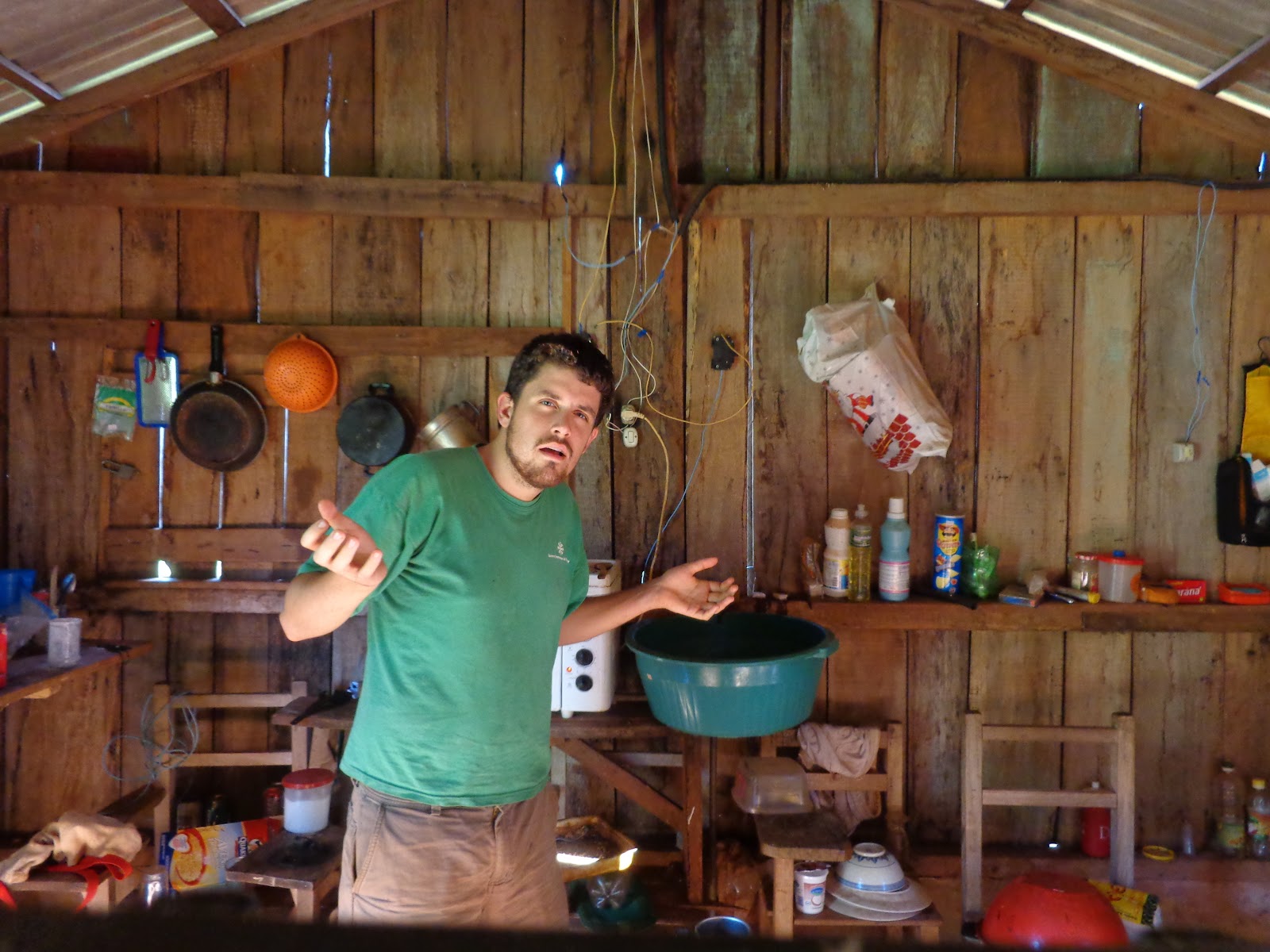
            For the volunteers who have lived around me this ongoing saga is old news, but for those of you back home hopefully the following will provide a glimpse into the life of yours truly. In previous entries, I have discussed my house and how it came to be. Aside from the four walls, two windows, two doors, and an electrical connection to the main line, my house had virtually nothing. The months of March-April, 2012 an uphill battled ensued getting my house up to a standard of living that I considered acceptable. This included building a bathroom and putting lights on the inside and outside of the house. The majority of the electrical work was done for free by my host father and community contact Julio. In addition to being the Area Director of 7 schools he also has a field where he grows corn, a multitude of farm animals, and extensive experience in construction developed during his youth. What I brought to the table were principally naiveté, perplexed looks, and dumb questions. I had to pester Julio relentlessly for a month to have him help get my electricity, and house in working order. After over a month of waiting to finish everything, I got fed up and moved into my house, without power, where I lived for close to a week. It wasn't until after I returned from a week long training secession that I found my house was fully wired, and my front porch light was finally shining brightly illuminating my front lawn for the first time.
            I was elated, and thought that I would be on easy street for the rest of my service with regards to electricity. I had a water pump that filled a tank above my house that provided me running water, multiple outlets, and plenty of lighting. Little did I know that my house was connected to the main power line on the street by two metal hooks that hung precariously eight meters in the air. I quickly learned that if there were any disturbances in the line from a bird landing on them to the wind blowing gently that I would lose power to my whole house, and suffer the night in utter darkness. To make matters worse it was after daylight savings so it would begin to get dark around 5 in the afternoon. Seemingly everyday I would have to go ask a neighbor or Julio to fix my power. This entailed getting long stick of bamboo to move the metal hooks into the precise place where the electrical connection could be established. I quickly caught on to this trick and soon found myself fixing the problem independently. While highly inconvenient, I trudged forward until one day when the cable fried causing one of the metal hook to fall to the ground. My heart sank because, as mentioned, I know nothing about electricity. In a move that would cause any professional electrician's jaw to drop, I reattached the cable with a neighbor by reforming the metal hook, attaching it to a slit at the end of a bamboo pool, and hooking it to the necessary cable. The effect was something on par with Fourth of July fireworks celebration, but after the initial sparking I was once again joined the ranks of the electrified, not literally. When that happened again a month later I decided that enough was enough and I would look for a more permanent solution to my ongoing problem.
            In every instance when my power has gone out I have had a conversation with most my neighbors that goes something like this:

Neighbor: Your powers out.
Me: Sure is. I have no idea why?
Neighbor: Sucks.
Me: Yep.
Neighbor: You should talk to so and so I don't know.
Me: Where does he live?
Neighbor: Over there.
Me. Thanks.
Neighbor: No Problem

Now I'll concede that I am embellishing this a bit, but my interactions with my neighbors almost always happens this way. It also always happens when I am standing underneath my power line looking perplexed. Invariably someone will come along to help me, but it is only after a few days of me inquiring around. At the recommendation of Kristin, the volunteer who lived in the community next to mine at the time, I enlisted the help of squat, round-faced man named Blascito who is the go to "electrician" in her community that is 1 KM from my house.  Not only did he fix my problem the day I asked him about it, but he also used an old rickety ladder, that he had elongated by 2 meters, and permanently, or so I thought, fixed my power for a nominal fee. He had taken the two long hanging wires and secured them to the main power line. In doing so I never again needed to go out and fix my power with a long stick when it was disconnected by a minor change in the weather.
            That fairy tale ending, while life changing at that moment, would not withstand the test of time. The next series of problems occurred in the New Year, and started with my archenemies the cow. Having spent a marvelous two-weeks in beautiful Uruguay I returned to my derelict shake to discover that cows had ripped off my electrical connection to my house. Thankfully this was an easy fix, but a fix all the same that required the usual herculean effort to resolve. Thankfully it was the summer, and Julio was able to come over and resolve the problem immediately after some coxing. Next was the infamous plug, water pump, and light bulb explosions of February. Within 24 hours of each other I burnt out the main light in my kitchen, which normally would be an easy fix except that the bulb is located in the middle of the room about 9 feet in air just out of my reach in my tallest chair. A frayed wire giving way causing the one plug in my kitchen area to go up like a sparkler followed that situation. That forced me to cook my meals in my bedroom next my bed, which while opportune was hardly ideal. Then my water pump, never a good-looking one to start with, burnt out leaving me with no water. Similar to the cow situation it was the summer meaning that Julio had time to help me slowly but surly resolve these problems that included installing brand new water pump that worked like a dream.
The Main Line
            Now when I say worked like I dream I mean that last week it was stolen while I was away from my house. Someone around me likely saw me install it, and rightfully thought it would be a nice payday to swipe that when Thomas wasn't around. Sure enough when I got back my heart sank as I knew that I would have to temporarily relay on the good ole' fashion bucket and rope method to supply my water until I can put in a new pump, but that isn't even half the story. Within one hour of realizing my pump was stolen, my electrical connection burnt out leaving me powerless for four days. This time, Julio had resumed his job at the school meaning that I was up you know what creek without a paddle. I spent those four days in a somber mood to say the least.
            After a day, I was able to get Julio to come over to my house. He spent 15-minutes fiddling around the mess that makes up my poor mans circuit breaker before concluding he didn't know what the problem was and left without giving me advice. I was dumbfounded by his indifference towards my situation, and began having PST flashbacks from this time last year when he was erratically meandering over to my house to help me put the home, which he helped me find in the first place under the pretext of being there to help me out when I needed it, together. I then spent all of Friday wandering aimlessly around my neighborhood looking for people who could help my situation. That entailed borrowing a wobbly ladder weighing close to a metric ton from one neighbor, and being told the community electrical guy wasn't around because Sunday was the Presidential Election and nobody had time to help. To make matters worse, my two neighbors who usually help me when I have a problem with my house, so about every week, weren’t around. I then went to talk Blascito again hoping that the reliability he demonstrated last year would again shine through for long enough to get my situation resolved. I biked over to his house, and after blithering away in my stupendously average Guarani he told me he would come by at 3.
            From the moment he biked up to my house I could tell that the problem was far graver than I had thought. He informed me immediately that my main cables looked liked they had spent a period of time on the sun, and that I would need to buy about 22 meters of 4 mm electrical cable to fix it. The problem, however, was that the aforementioned wobbly ladder, despite having already been extended already, couldn't reach the height of the wires. He said that he would need to find some type of climbing spike to even attempt to fix the problem. Not having mountaineering gear handy, Blas went to find out if he could borrow some from a friend. As he was leaving my neighbor Alfredo, like the sauce, rolls up to tell me that he can fox it no problem as long as I buy the wire. It being four o'clock on the Friday before the national elections were to occur and with daylight dwindling I jumped on my bike and booked it to the closest hardware store in the center of O'Leary. As I Flintstoned braked from about 300 meters before the hardware store, my bike currently doesn't possess brakes, I realized that I had set a personal record for the 2 KM distance from my house to the center of town. I quickly bought the needed wire a booked it home with plenty of time to fix the power. To avoid the height problem of my previous power situation Alfredo connected the wires to the electric poll that the school uses. Alfredo heroically fixed my power even though I almost killed him through my use of a crappy ladder that broke halfway up as he was climbing to make the final connections. In spite of all that we fixed the ladder, and more importantly my power that has been working, knock on wood, ever since.
            I am sure that more problems will present themselves in my remaining eight months in Paraguay. I realize this entry makes it seem like I have learned nothing, and to be honest that isn't too far from the truth. I have, however, experienced my own brief moment of redress when I successfully was able to rewire my back porch light last November. Having triumphantly reattached the burnt wiring, my chest swelled with pride as I flipped the switch to see the light bulb illuminate my backyard as I stood there with a smug smile on face. I have to say, though, boasting about an accomplishment of that nature to Paraguayans is far from satisfactory given their general knowledge of how to wire something. In my incessantly ramblings about my accomplishment within 3 days of finally fixing a problem on my own the bulb jettisoned from its mount and shattered all over the ground. I guess next time I'll hide my hubris.