Search This Blog

Tuesday, April 23, 2013

Shocking Revelations


            Ever since arriving in Paraguay I have had several epiphanies concerning my lack of vocational abilities in maintaining a home or physical structure. My ineptitude in this regard can be explained in any number of ways, but for simplicity sake I'll concede that the primary reason is that I can get anything I ever needed fixed or replaced by picking up the telephone. Car broken? Take it to Jiffy lube. Yard in disarray? Call a landscaping company. Power went out? Get a hold of the electric company, and so on and so forth. What amazes me is that the convenience that exists in the states is something that I greatly took for granted before I moved to Paraguay. To be fair to myself, how could I have expected the challenges associated with house upkeep having never lived alone or in my own house? Not ever having needed those skills with any degree of regularity allowed me to prioritize other things like sports and television. Growing up in America in the time period I did greatly shaped what skills I fostered during my upbringing and educational development. Paraguay, however, is very much a developing country that I have on numerous occasions compared to America in the 1930s-50s with regards to the necessity of being handy. The main reasons I draw that comparison is because of the rudimentary handyman skills that most Paraguayan men possess far exceed the handyman skills I have. This necessity translates into Paraguayans living almost completely self-sufficiently.
            What I mean by self -sufficient is not that they most families live in a completely sustainable situation where they are not dependent on anyone for their survival. I am more referring to how all Paraguayans, particularly ones in countryside, are able to do everything from grow a good portion of there food, to building a house from the ground up. Common knowledge includes, but is not limited to plumbing, electrical wiring, carpentry, construction, animal husbandry, and agriculture. When you start a family here it is the norm, rather than the exception, to build your house, or at least expand it as your family grows, maintain a garden or small field, keep a variety of animals, install modern plumbing, and last but not least wire your own house. I could write anecdotes about all of these subjects, but since I moved into my house a year ago it has been my ongoing battle with trying to stay on the electrical grid that has been the catalyst of my frustration regarding my lack of trade skills.
My Circuit Breaker
            For the volunteers who have lived around me this ongoing saga is old news, but for those of you back home hopefully the following will provide a glimpse into the life of yours truly. In previous entries, I have discussed my house and how it came to be. Aside from the four walls, two windows, two doors, and an electrical connection to the main line, my house had virtually nothing. The months of March-April, 2012 an uphill battled ensued getting my house up to a standard of living that I considered acceptable. This included building a bathroom and putting lights on the inside and outside of the house. The majority of the electrical work was done for free by my host father and community contact Julio. In addition to being the Area Director of 7 schools he also has a field where he grows corn, a multitude of farm animals, and extensive experience in construction developed during his youth. What I brought to the table were principally naiveté, perplexed looks, and dumb questions. I had to pester Julio relentlessly for a month to have him help get my electricity, and house in working order. After over a month of waiting to finish everything, I got fed up and moved into my house, without power, where I lived for close to a week. It wasn't until after I returned from a week long training secession that I found my house was fully wired, and my front porch light was finally shining brightly illuminating my front lawn for the first time.
            I was elated, and thought that I would be on easy street for the rest of my service with regards to electricity. I had a water pump that filled a tank above my house that provided me running water, multiple outlets, and plenty of lighting. Little did I know that my house was connected to the main power line on the street by two metal hooks that hung precariously eight meters in the air. I quickly learned that if there were any disturbances in the line from a bird landing on them to the wind blowing gently that I would lose power to my whole house, and suffer the night in utter darkness. To make matters worse it was after daylight savings so it would begin to get dark around 5 in the afternoon. Seemingly everyday I would have to go ask a neighbor or Julio to fix my power. This entailed getting long stick of bamboo to move the metal hooks into the precise place where the electrical connection could be established. I quickly caught on to this trick and soon found myself fixing the problem independently. While highly inconvenient, I trudged forward until one day when the cable fried causing one of the metal hook to fall to the ground. My heart sank because, as mentioned, I know nothing about electricity. In a move that would cause any professional electrician's jaw to drop, I reattached the cable with a neighbor by reforming the metal hook, attaching it to a slit at the end of a bamboo pool, and hooking it to the necessary cable. The effect was something on par with Fourth of July fireworks celebration, but after the initial sparking I was once again joined the ranks of the electrified, not literally. When that happened again a month later I decided that enough was enough and I would look for a more permanent solution to my ongoing problem.
            In every instance when my power has gone out I have had a conversation with most my neighbors that goes something like this:

Neighbor: Your powers out.
Me: Sure is. I have no idea why?
Neighbor: Sucks.
Me: Yep.
Neighbor: You should talk to so and so I don't know.
Me: Where does he live?
Neighbor: Over there.
Me. Thanks.
Neighbor: No Problem

Now I'll concede that I am embellishing this a bit, but my interactions with my neighbors almost always happens this way. It also always happens when I am standing underneath my power line looking perplexed. Invariably someone will come along to help me, but it is only after a few days of me inquiring around. At the recommendation of Kristin, the volunteer who lived in the community next to mine at the time, I enlisted the help of squat, round-faced man named Blascito who is the go to "electrician" in her community that is 1 KM from my house.  Not only did he fix my problem the day I asked him about it, but he also used an old rickety ladder, that he had elongated by 2 meters, and permanently, or so I thought, fixed my power for a nominal fee. He had taken the two long hanging wires and secured them to the main power line. In doing so I never again needed to go out and fix my power with a long stick when it was disconnected by a minor change in the weather.
            That fairy tale ending, while life changing at that moment, would not withstand the test of time. The next series of problems occurred in the New Year, and started with my archenemies the cow. Having spent a marvelous two-weeks in beautiful Uruguay I returned to my derelict shake to discover that cows had ripped off my electrical connection to my house. Thankfully this was an easy fix, but a fix all the same that required the usual herculean effort to resolve. Thankfully it was the summer, and Julio was able to come over and resolve the problem immediately after some coxing. Next was the infamous plug, water pump, and light bulb explosions of February. Within 24 hours of each other I burnt out the main light in my kitchen, which normally would be an easy fix except that the bulb is located in the middle of the room about 9 feet in air just out of my reach in my tallest chair. A frayed wire giving way causing the one plug in my kitchen area to go up like a sparkler followed that situation. That forced me to cook my meals in my bedroom next my bed, which while opportune was hardly ideal. Then my water pump, never a good-looking one to start with, burnt out leaving me with no water. Similar to the cow situation it was the summer meaning that Julio had time to help me slowly but surly resolve these problems that included installing brand new water pump that worked like a dream.
The Main Line
            Now when I say worked like I dream I mean that last week it was stolen while I was away from my house. Someone around me likely saw me install it, and rightfully thought it would be a nice payday to swipe that when Thomas wasn't around. Sure enough when I got back my heart sank as I knew that I would have to temporarily relay on the good ole' fashion bucket and rope method to supply my water until I can put in a new pump, but that isn't even half the story. Within one hour of realizing my pump was stolen, my electrical connection burnt out leaving me powerless for four days. This time, Julio had resumed his job at the school meaning that I was up you know what creek without a paddle. I spent those four days in a somber mood to say the least.
            After a day, I was able to get Julio to come over to my house. He spent 15-minutes fiddling around the mess that makes up my poor mans circuit breaker before concluding he didn't know what the problem was and left without giving me advice. I was dumbfounded by his indifference towards my situation, and began having PST flashbacks from this time last year when he was erratically meandering over to my house to help me put the home, which he helped me find in the first place under the pretext of being there to help me out when I needed it, together. I then spent all of Friday wandering aimlessly around my neighborhood looking for people who could help my situation. That entailed borrowing a wobbly ladder weighing close to a metric ton from one neighbor, and being told the community electrical guy wasn't around because Sunday was the Presidential Election and nobody had time to help. To make matters worse, my two neighbors who usually help me when I have a problem with my house, so about every week, weren’t around. I then went to talk Blascito again hoping that the reliability he demonstrated last year would again shine through for long enough to get my situation resolved. I biked over to his house, and after blithering away in my stupendously average Guarani he told me he would come by at 3.
            From the moment he biked up to my house I could tell that the problem was far graver than I had thought. He informed me immediately that my main cables looked liked they had spent a period of time on the sun, and that I would need to buy about 22 meters of 4 mm electrical cable to fix it. The problem, however, was that the aforementioned wobbly ladder, despite having already been extended already, couldn't reach the height of the wires. He said that he would need to find some type of climbing spike to even attempt to fix the problem. Not having mountaineering gear handy, Blas went to find out if he could borrow some from a friend. As he was leaving my neighbor Alfredo, like the sauce, rolls up to tell me that he can fox it no problem as long as I buy the wire. It being four o'clock on the Friday before the national elections were to occur and with daylight dwindling I jumped on my bike and booked it to the closest hardware store in the center of O'Leary. As I Flintstoned braked from about 300 meters before the hardware store, my bike currently doesn't possess brakes, I realized that I had set a personal record for the 2 KM distance from my house to the center of town. I quickly bought the needed wire a booked it home with plenty of time to fix the power. To avoid the height problem of my previous power situation Alfredo connected the wires to the electric poll that the school uses. Alfredo heroically fixed my power even though I almost killed him through my use of a crappy ladder that broke halfway up as he was climbing to make the final connections. In spite of all that we fixed the ladder, and more importantly my power that has been working, knock on wood, ever since.
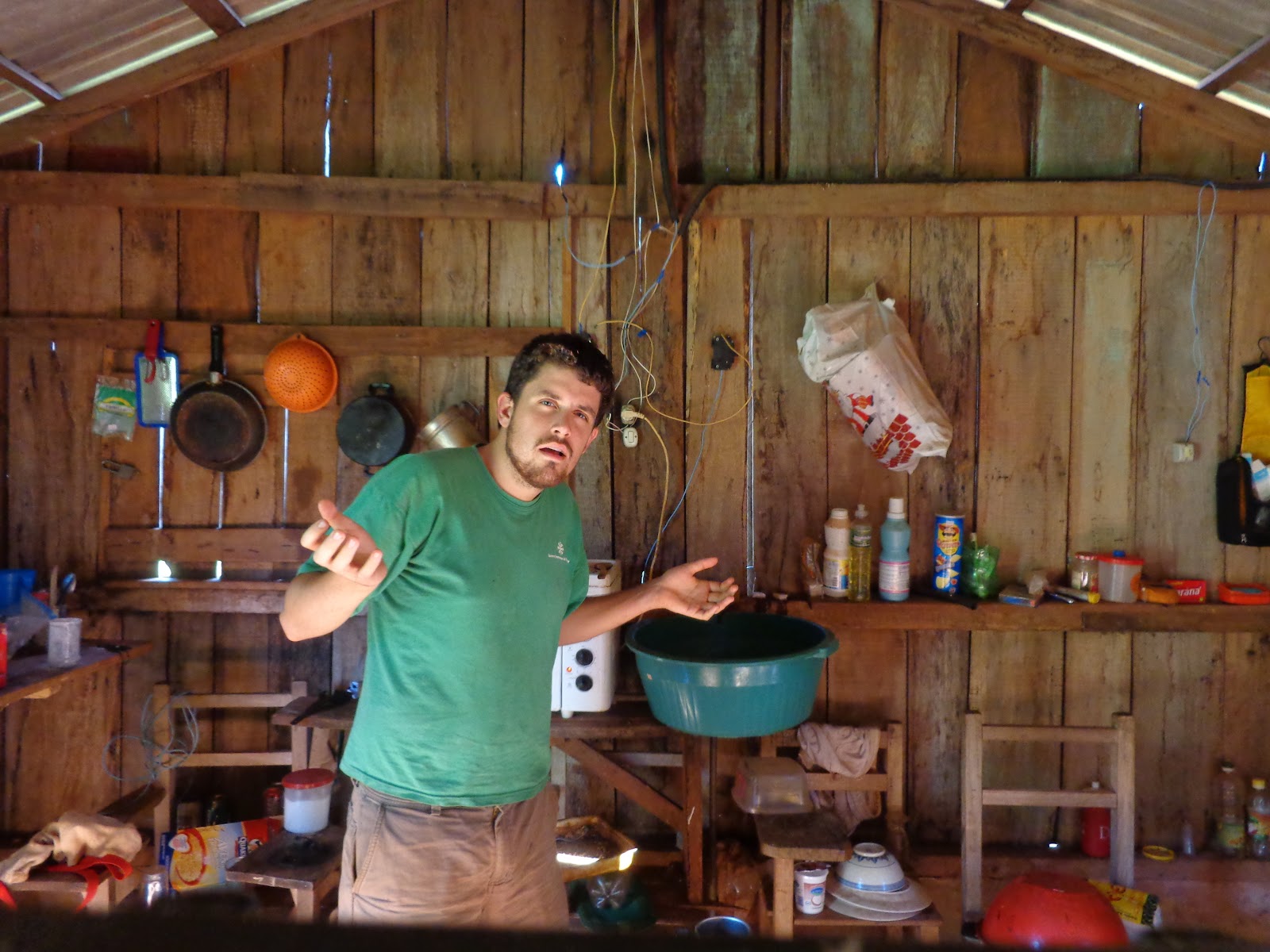
            I am sure that more problems will present themselves in my remaining eight months in Paraguay. I realize this entry makes it seem like I have learned nothing, and to be honest that isn't too far from the truth. I have, however, experienced my own brief moment of redress when I successfully was able to rewire my back porch light last November. Having triumphantly reattached the burnt wiring, my chest swelled with pride as I flipped the switch to see the light bulb illuminate my backyard as I stood there with a smug smile on face. I have to say, though, boasting about an accomplishment of that nature to Paraguayans is far from satisfactory given their general knowledge of how to wire something. In my incessantly ramblings about my accomplishment within 3 days of finally fixing a problem on my own the bulb jettisoned from its mount and shattered all over the ground. I guess next time I'll hide my hubris.


Sunday, March 31, 2013

Chipa II


       Last year, I wrote a long entry about Paraguayan cuisine that specifically focused around what the famous Paraguayan author Agusto Roa Basto described as “fragrant, golden rings” in his well-known book entitled “Hijo del Hombre” (Son of Man). What I was referring to is more than just a simple food that people here enjoy with a passion unparalleled by any equivalent food in America. It is called chipa, and to say that it is just a food would be an insult to the Paraguayan way of life. Simply put, chipa is more or less a tough corn and manioc flour cake that is consumed in every corner of the country, and I am certain would illegal in the States to make without serious oversight of the necessary ingredients. Despite individual families’ variations it is essentially made using the same ingredients with little variation. Every Paraguayan from infancy throughout their entire lives is exposed to copious amounts of the biscuit like treat. However, its importance stretches into the religious fabric of the country because during Easter and the week leading up to Easter, families bake bountiful amounts of chipa in their back yard ovens known as tatakuas. The chipas are to be eaten as the primary source of food starting on good Friday and ending on Easter Sunday. In other country’s the tradition is to fast or just to avoid meat, but in Paraguay all you eat is chipa, which let me tell you after two days is sort of sitting out on the table, the chipa transforms into a sort of crumbling rock that even the dogs struggle to chump through. This time last year, I was starving on Easter Sunday because of said tradition, and was immensely relieved once Easter was over that our diets could resume normally through the reintroduction of proteins.
      This year my perspective was different in that I now live alone. That allows me the privilege to make chipa, receive chipa, but not depend on it as my only form of sustenance during the week. Having made chipa already one time before with my host family during the three month training period I was somewhat familiar with what the primary components to construct the perfect chipa were, but didn't truly appreciate the importance of the process until recently. For the record, I find chipa to be a food I only choose to eat when no other options exist, or when it is given to me by someone who asks if I’m hungry. With time, I have grown to appreciate the taste and the subtle nuances that exist between different kinds, but to date, I cannot say I will be craving it once I am not longer in position to purchase it back in America. I think my personal taste preferences initially limited my ability to appreciate chipa for what it is to Paraguayans. I cannot honestly say I have never met a Paraguayan who doesn't like chipa or doesn't know how to make it. You would have to blind not to know what it is especially because it can be purchased on any long distance bus going anywhere in the country.
      Bus companies have unspoken agreements with chipa individual chipa vendors for the right to sell their chipa on their buses  Women, normally heavier set women for reasons that become obvious upon a brief glace at the ingredients that go into chipa, board the buses with an enormous basket containing hundreds of chipas that sell for roughly $0.50 each. You can always tell when the chipa lady, most often it is a woman, by how everyone on the bus starts digging around their wallets and purses, and how everyone seems to come to life as the lady bumps back and forward in between the aisle with basket that appears almost as big as the woman carrying it on her shoulder. Remarkably the women usually sell most of her stock on one bus, particularly if it is early in the morning. Her enormous basket with the intricately folded white cloth that contains and maintains the chipas temperature gradually shrinks from mountain to a small mound in a matter of minutes. The ladies selling the chipas somehow are able to maintain balance in spite the ridiculous speeds the lunatic bus drivers seem to maintain no matter how much traffic there is on the road. They are also simultaneously able to break change and put each chipa in a small plastic bag with the logo of the chipa company on the front. Aside from the comically large basket these women hoist on their shoulders, the uniform of the chipa vendor is usually a shirt polo shirt with a certain color fringe and the logo of the company over the heart. Usually the woman wears shorts skirts and hose the former of which matches the tinge of the polo. I don’t know exactly how many runs the average vendor does in a day, but I do know that they are apart of an elite group of contributors to the economy that work rain or shine and on weekends and holidays. They will board a bus whether it has 10 people sitting rows away from each other, or whether it has 100 passengers crammed in every seat and stuffed in every square foot of the aisle. Nevertheless, if you by some horrible stroke of bad luck are on a bus where a chipa lady doesn't get on, lets just say because one couldn't hop aboard the bus with a 30 pound basket on her shoulder with a bus driver that refuses to go slower that 10 mph when passing, there is no need to fret because at every bus terminal in the country one will be accosted by 5-15 people each selling one of six things one of which will always be chipa. In fact, on the four-and-a-half hour bus ride from Asuncion, the capital of Paraguay, to Juan E. O’Leary, where I live, the average patron will have no less than four opportunities to buy chipa from someone and often times more than that.
       The culture of bus chipa, in many ways, is its own unique subculture from the traditional heritage that developed over hundreds of years. Sure the ingredients are the same, but they are mass produced for the populace and only half the times are backed in the traditional tatakua. For me that commercialization is sort of the equivalent of eating grandmas home made biscuits versus Pillsbury ready to bake. Sure the commercialized version that claims to taste like grandmas are good, but it’s just not the same. That feeling is very analogous to the chipa industry here. Despite commercialization efforts to push grandma so-and-so’s chipa or patron saint of whatever’s chipa nothing tastes quite the same as the stuff made at home.
       Making chipa is a simple enough process, but like all true homemade delicacies there is a procedure that has been mastered only after the knowledge has been passed down for generations and with years of practice under one’s belt. So to say that my abilities are novice-like is spectacular understatement. Sure I can get the method down easily enough, but the making of the chipa doesn't have roots in my genetic heritage, so I have to willingly accepted that I will always, in spite of my best efforts, be a goofy outsider when it comes to making the Paraguayan snack of the Gods. This past Wednesday I was invited over by a neighbor who let me help her make her chipa for the week. The following is her process that is pretty much universally accepted throughout all corners of Paraguay. Describing chipa and its production method in a way that truly hits home for most Americans I will once again emphasize the analogy of mom or grandma’s homemade rolls or biscuits. Sure the frozen ones are good, but they aren't the same. A reason for that might be because somehow grandmas knows better than to settle for whatever the grocery store has to offer as a substitute to an important component. But in America today, a lot of the ingredients are things that we no longer have ready access to because we didn't grow up on a farm or close to an area where we could get fresh milk or eggs. Paraguayans, for the most part, still have access to those fresh ingredients that seem to have disappeared from the American household, and therefore the rustic identity of homemade chipa is still very much a part of the cultural identity.

      To make about 100 chipas one must have the following ingredients: 2 dozen eggs (preferably laid from your own chickens), 1.5 kilos of pig fat aka lard (Crisco or another fat substitute has yet to make headwind in the Paraguayan marketplace), 2-3 kilos of finely ground corn flower (again preferably your own corn that you ground yourself), 4 kilos of manioc flower (naturally grown and ground yourself), 100-200 gram packet of anis seed (smells and tastes like black liquorish), 1.5-2.5 kilos of Paraguayan cheese (really difficult to describe this, but imagine taking fresh milk from your cow and being able to make a solid block of slightly smelly, soft, white cheese that is ready to use in a variety of foods the next day), and lastly a pitcher full of salty milk that one adds to taste. Once all your ingredients are gathered the process of mixing takes on its own unique process. First, you mix the lard, the eggs, and a portion of the corn flower together until you create a yellowish paste that masks the smell of the eggs. You add corn flower accordingly until you achieve the desired result. Next you start kneading in the rest of the corn flour and the entire 4 kilos manioc flour along with the anis seed and salt milk until you get lumpy looking dough. Then add the cheese, depending on how cheesy you want it, and fold that into the mixture. The cheese is typically soft, and blends in well if it is fresh. However, that is not a requirement and the older the cheese the worse it tastes when one is unexpectedly given a piece. After the entire tub is in a dough form each chunk is kneaded again until smooth, and it typically shaped in a circle, a think log, or a bun, but it can really be molded into whatever you want because the texture is a lot like Play dough.
                                                     Once the arduous task of forming all the chipas is completed one must cut down 2-3 banana tree leaves that serve as the base for the chipa as it is put in the tatakua. A tatakua is a small brick oven that is made from cheap adobe bricks formed around iron rebar, and covered with adobe paste. One heats the tatakua exclusively by burning wood. Needless to say that Paraguay utilizes the tatakua for many other cooking purposes, and is therefore South America’s number one per capita consumer of firewood as a result. Once oven is hot enough you throw in the chipas much like you would for a pizza in a brick oven, wait 15-20 minutes and before you know it you are chewing on a delicious piece of golden brown chipa. Unfortunately, right out of the oven and hot is really the only time that it is chewable without having the fear of breaking ones teeth. You can reheat it the next day, but it’s not the same, and after 2 days of sitting out it is close to inedible. In reality, chipa can be eaten at all times of day regardless of the weather and temperature. Most commonly it is eaten for breakfast with a steaming cup of cocido, which is burnt yerba mate and burnt sugar brought to a boil with water or milk then drank scalding hot with copious amounts of sugar that makes feel like you are contracting diabetes and cancer at the same time. Families all over Paraguay make chipa the week leading up to Easter, and eat it throughout. It is an important food, but a more important component of a happy family that lives and shares together. It kind of reminds me of making Christmas cookies with my Mom and Grandma during the holiday season.
      As for my personal opinion concerning chipa, all I’ll say is that it is an acquired taste. I’ll eat it, especially when its fresh, but I am not sure that I would be able to eat it frequently without wanting to kill myself as it sits in my stomach like a brick. Since arriving I have seen chipa made in many places, particularly close to where I live, and just like anything everyone has their specific methods and details that go into making their own family’s chipa. I guess what it was about the whole culture of the flaky, rock hard, Paraguayan indulgence that inspired me to write about it again has to do with the fact that it is Easter again, and I am not home with my family, again. Although everything about the taste and the process of making it is totally unique, the values transcend culture, and make me a bit homesick. With that I’d like to say Happy Easter to my family at home particularly to my Mom and Grandma who I am sure made something special, that I cannot wait to have again soon, for everyone at home.

Tatakua


The final product


Friday, March 15, 2013

My Home Landscape


       At various points of my service I have discussed gardening in a variety of different contexts. One of the big objectives of Environmental Conservation Volunteers as well as the Paraguayan Ministry of Education are school garden projects. In the past, I have written about my experience in creating a school garden that turned into a rather impressive cornucopia of vegetables. However, I also mentioned that said school garden was counter intuitively planted and managed by patents of the students rather than the students themselves for a variety of reasons that I will not dive into in this entry. Nevertheless, I would strongly encourage you to check out previous postings if you are interesting in hearing my grips about it. Gardening, specifically horticulture, was something that I had been exposed to at different points in my up bringing, but it was never a cornerstone of my family’s efforts in maintaining the landscape of our home. The reason I felt particularly inspired to write about this topic stems my recent acquisition of Michael Pollan’s Second Nature in which he discusses at length his personal trials and tribulations to sow an organic garden in his home in Connecticut throughout the year. The book touches on a broad assortment of topics ranging from his exposure to gardens and landscapes from his childhood, pests, weather, and the backdrop of American homes throughout the country. To date, I have yet to finish the book, but nevertheless felt compelled to relay my experiences in my Paraguayan landscape, aka my home here, to that of what my previous relationship had been in America.
       Pollan writes extensively about his Russian immigrant grandfather whose greatest passion was the pursuit of a perfect garden and home landscape. Pollan reflects on visiting his grandfather’s well kept lawn, flowering fruit trees, and immaculate garden as sort of Eden as a youth growing up in New York. His father, on the other hand, was conversely put off by the incessant maintenance of the garden/landscape of his home to the point where he would boycott cutting his own front lawn. That refusal to adhere to the unspoken agreement Americans seem to have about maintaining their home landscapes in many made ways made Pollan’s family renegades in the eyes of their neighbors. That particular section of Second Nature had me laughing reflecting on the at times titanic struggle my father had with me growing up in maintaining our lawn.
       Every week my Dad would subtlety attempt to mentioning that the lawn was looking a bit shaggy. I would always protest that I had just cut it the week before whether or not that was true or not. I would argue that beleaguered point until my allowance was threatened to be withheld if I did acquiesce and do it. I would bitch and moan unremittingly as I pulled out the red push mower, the gas can, and the garbage bin that we used to dump the grass clippings in. Inevitably my father was always right when he said the lawn needed a cut. I always thought this to be true because I would constantly get our little red mower clogged with grass that I had let grow too long. I was the main caretaker of our lawn from about 12-19 after which point I headed off to college and much to my relief, my responsibilities were forever relinquished to landscaping company. I still remember very clearly my father teaching me how to prime the lawnmower, check the oil, and pull the rip cord. The feeling of getting overly frustrated if I flooded the engine, cut too close to the turf, or was unable to get those tricky hedges that lied on the edge of brick walls or tree trunks are still unpleasant memories to this day. My father in teaching me how to mow the lawn was his genius way of pawning responsibility of lawn maintenance to his ignorant son who initially was so thrilled that he was allowed to operate a cool looking machine like a lawn mower that he had no idea that my weekends every spring, summer, and fall would inevitably be partially occupied with cutting the grass. I will always remember him meandering down the small path inlaid with rocks to step on underneath the huge maple tree in our front lawn, hands behind his back with a smug grin on his face admiring my work, but not shying away from mentioning a spot I missed or whether or not there was too much excess clippings on the ground. Easily some of the fiercest arguments that I ever got into with my Pop were over that stupid lawn. I never cared what other people in the neighborhood thought about it. All I knew was somehow every weekend throughout the summer I was sweating buckets cutting a lawn that I progressively grew to hate with passing summer. I never understood why it was important to maintain that lawn I as meticulously as my parents wanted. Even today, to a large extent, I still don’t quite get it especially after living in Paraguay.                       
     Most Paraguayans, if they have grass, cut it with there electric plug in motors with long extension cord or giant weed whackers no more than 3-4 times a year. Granted grass here isn’t treated with chemicals to maintain a pristine green throughout the summer months, but all the same the work that is done around the house is more focused on sweeping up leaves from trees and the various manures from farm animals that roam around. Keeping my lawn in a presentable state is further limited by the fact that the only lawn care maintenance object that I can afford is a long machete, which in turn leaves me incessantly toiling with a huge array of weeds that grow back faster than I can cut them down. The frustrating thing is that my lawn had been well maintained by a series of cows that my neighbors would tie up in my yard. This was a good deal for me because not only did not have go through the arduous process of cutting my whole lawn with a machete, but the cows would also provide manure that I could use in my compost for my garden. However, starting in November I noticed that the cows were no longer pulling their weight with lawn maintenance. I believe was the result of higher amounts of rain that have sustained a semi-continuous frequency since. That as a result has led to my lawn to appear more as an abandoned lot than one in which a person lives. The problem is that so often are land plots, houses, or fields up and abandoned from people moving, selling their land, or whatever the reason, the areas in my immediate vicinity are equally unattractive or worse. With that lack of a higher standard to aspire to I am content with a much less acceptable looking lawn. Paraguayans, also, demonstrate displeasure in things in much less direct methods than I feel people would back home. I don’t have neighbors insulting my lawn to my face, writing me a note signed by some home owners association, nor are there real estate agents trying sell land in the area that’s costs is driven down by my unsightly lawn. That being said it still think I have gotten to a point where I have flirted with the edge acceptable appearance for too long, and likely will give into my own self-perpetuated guilt and just cut it.
       Pollan goes to great lengths to describe the American fascination with lawns as a defining characteristic of the American home. In Paraguay the lawn, while important to maintain if you have it, is not the first thing people will associate with a nice looking house. From my summation I would have to say that flowering fruit, shading, and ornamental trees exemplify how “hermosa”, beautiful, a home is. Additionally, how well maintained ones garden or field is seems to provide the fodder for criticisms of ones status within the community. In a similar way Americans value the lawn and flowery landscape that it surrounds, Paraguayans value something similar in how nice their rows of corn or manioc look. If your crops aren’t in a straight line, well protected from animals, or contains too many weeds in-between the plants it is likely you might get a snide remark from your neighbor. The same applies with gardens. One must dig their seed bed in perfect rectangle, plant the seeds in perfectly spaced distances, and perfectly layer compost such that everything appears uniform. Regardless of whether or not that manner will yield the best looking vegetables a term volunteer’s coin as the “lindo factor”, pretty factor, and trumps most alternative methods of increasing yields. If it cannot be incorporated in a nice organized manner I am not interested in the unspoken reality many people face when working with plants. Going to the extreme of planting tomatoes and parsley all helter skelter in the same seed bed, while mutually beneficial to the plants, does not appear lindo and therefore makes it difficult to justify when working in a school or family garden. This was the case when I attempted to plant lettuce, Swiss chard, and onions at the school garden. While the kids didn’t do the best job planting properly, it was obvious that things would grow, but the three seeds beds we planted quickly got reorganized by the parents to make things look slightly nicer. This cultural appreciation for plant organization shouldn’t of surprised me because we do that sort of stuff with own homes in America.  
       My mother had always spent a great amount of time tending to the many flower beds we had throughout our front and back yards. I remember every spring being called out to the car to unload gargantuan bags of mulch and fertilizer to yet again begin with the planting of a wide cadre of impatiences, tulips, and marigolds for some reason stand out, but there were also perennials that despite my best efforts to destroy with a plastic sword managed to come up every year. Similarly to my experience with the lawn, at first I thought planting flowers and plants was fun. I liked making a brown patch of dirt transform into a array of brilliant colors that flowed tougher to create a totally unique landscape that was only limited by what could you could imagine, or what plants you happened to have. My family has always dabbled in vegetables, but aside from the occasional tomato plant or two that would often succumb to deer’s or other pests, the mark of yards were the somewhat well manicured lawn, enormous hundreds of years old trees, and the flowers my mother planted.
       So needless to say when I learned about the importance of promoting gardening in Paraguay I was very excited to try my own hands at growing things from seeds, but as most novice horticulturalists are bound to find out things are not as easy as they seem. I always that the dichotomy of what I am supposed to be able to help teach Paraguayans, particularly gardening, are often times things they themselves know how to do a lot better from years of experience. The American wondering up to the 40-year-old farmer trying to ask them in broken language about their garden doesn’t exactly instill confidence in your ability to improve their current method of growing things. In most cases, that skepticism is not unfounded. In my case, I spent the first 4 months from the time I moved into my house trying to build and plant a garden. In order to do so I had to build some kind of rudimentary fence out of bamboo that ended up taking several months due to the fact that my only free source of bamboo was about a kilometer from where I lived. As I would walk past numerous households with an arm full of bamboo often times in toe with a friend, people would stop and stare. It wasn’t so much that I was carrying the bamboo I think it was more curiosity as to what I was going to with it. Again people more often than not are surprised when I try to make suggestions about gardening. Me not having a garden was further evidence that I did not in fact know what I was talking about. By the time I had finally constructed the fence and installed a door using old flip flops as hinges was I able to begin my meager attempts to plant stuff.
       In my mind, I envisioned not ever needing to go to the store to get vegetables, and therefore bought seeds for carrots, onions, lettuce, Swiss chard, tomatoes, peppers, and parsley. I was also lucky enough to get broccoli to transplant from the excess plants the school had. At the end of 4 months of toiling around I ended up with meager looking lettuce, broccoli, Swiss chard, and few pathetic looking tomatoes. I could point to numerous reasons for my failures, but at the end of the day the blame stops at me alone. I didn’t do a good enough job limiting sun exposure, consistently watering when I had to leave for whatever reason, or preventing animals from breaking down my fence to much on my paltry results. My timing was also off, and by the time I actually got tomatoes to grow someone entered my garden in the middle of the night to steal the 11 measly looking fruits that I had worked so hard to obtain. I knew that it wasn’t going to be easy, but what I didn’t know was how uneasy it was going to be. So for this year I am determined to improve upon last years learning experience and achieve better results. Will those results be adequate to prove my value in the community I live in? My answer to that is probably not, but even if it was I am resigned to the fact that by the time I get my garden up to snuff it will be close to the end of my service that will lead me back to another landscapes in another pocket of the world to start all over again.

Monday, February 25, 2013

Miguel

       Since I started writing this blog almost a year and a half ago I have composed the majority of the entries after a particular moment or event that I felt warranted documentation. To this point, I have been unable to comment on my connections with individuals that I have interacted with not just in O’Leary, where I live, but in Paraguay in general. For volunteers all over Paraguay, and I assume all over the world, it is easy to generalize the people we live, work, and develop relationships with as an amorphous categorization. Classifying every host country national as “The Paraguayans” is what I say. The Paraguayans this and the Paraguayans that have become a second nature to me, and dominate my own individual categorization for my interpersonal relationships for numerous reasons. Principally I believe that the bulk of my conversations I have with non-Paraguayans are with other volunteers in Paraguay.  The obvious reason for that is that they too are relatively isolated within a similar cultural context. I feel as though that limits my ability to candidly discuss my Paraguayan friends and contacts to people who don’t know the individuals I have grown close to in any finite detail, or to anyone who reads this blog. I feel as though it is essential that I somehow delve into the relationships that I have formed over my time here, but I have struggled mightily to find someone to write about that I feel encompasses what it means to be a Paraguayan now and will it’ll mean in it’s future. After much thought on this topic my interaction with one student at the school I live next to have provided me with the inspiration to scratch the surface of the impacts the people here have had on me. I feel strongly that no one including  my neighbors, friends here, or even families I feel I don’t know well who see my passing by their house on my bike everyday know it or not the people here have had more impact on me than any other aspect of this experience. In particular my limited but significant interaction with a 6th grade student named Miguel has given me a fascinating perspective of being young and in Paraguay more than he will ever know.
       Before I go into details about the interaction I have had with Miguel it important for me to mention that many of the details, events, and facts of this story are things that I inferred from somebody telling me something, or are my own interpretation of details I heard from hearsay. That in and of itself is important to point out because of how prevalent the nature of orally passing information is in small communities here in Paraguay. At times I feel as though I get most information about news in Paraguay, things happening in the community, and problems from gossip or just hearing people talk. Too often I don’t get it. Some of that has to do with language ability, and my lack of familiarity with the historical social interactions between groups of people that live here. I also often miss colloquialisms that people use when describing certain situations. To date, I am sure that my own personal existence here was and is a big topic of conversations amongst people around me that I am not wise to at all. With that being said I’ll remind anybody reading this that again these are my opinions not always based on fact or logic; two things that are not always the most important in the tittle-tattle of the community.
       I first met Miguel about a year ago when school started. He stood out for a couple of reasons the most being that he had red hair in a class of seven other 6th grade students who all had darker hair At the time, my language ability was shoddy and I had a hard enough time communicating in Spanish let alone Guarani. That meant when I walked into the 6th grade classroom for the first time to do an activity as a precursor to the world map we later painted,  I must come off as a big joke. I still remember struggling to instruct the students to draw to the best of their abilities a map of the world. Everyone in the class sat their in silence, including Miguel, for at least 2-minutes before the teacher came back and said something in rapid fire Guarani that got them sort of working. Miguel lives with his uncle and 5 cousins at one the houses down the street from the school 40 yards from where I live. His uncle, a short man everyone refers to as Torito (Little Bull) for reasons that always seem to come back to his genitals, had built my bathroom on my house with help of Miguel. During the school year when he wasn’t in school I would see him wondering around the neighborhood shooting birds with a sling shot, picking fruit, or playing soccer. I would see him almost everyday doing something, but remarkably enough he would never talk to me. I found Miguel, for unknown reasons, to be incredibly shy towards me. I assume a lot of it had to do with his tendency to speak Guarani first over Spanish, but I also thought it could be as simple as me being intimidating looking and foreign. As more time past he would reluctantly come over to my house with his cousin Allie to pick mandarin oranges. With time, and candy I had shipped from the states, he would come over to watch me do whatever I was doing at that time. It didn’t matter if I was just sitting outside my house, working on my garden fence, or cooking Miguel would just show up. He wouldn’t say much if he said anything at all, and would leave after no more than a half an hour. This was a regular visit several times a week for my first couple of months in my house until all of a sudden it stopped.
       He was still going to school, but with a noticeable lack of frequency. After a while I asked the teachers what happened to Miguel. They told me that he moved back in with his mother who lives in the next barrio (neighborhood) over from me. I remember asking this question on a random school day in which he should have been there. I asked if was going to another school, and was told no. I then had to ask the seemingly obvious question of where was he. The remarkable thing about what teachers said to me was how nonchalant they were in their response. It was as if it was common for a kid like Miguel to be that situation that it barely warranted a second thought. They informed that his mother was very poor and was making him work at one the brick making places that are riddled throughout the area. Furthermore they mentioned that not being in school wasn’t good for him, but for obvious reasons were powerless to do anything about it especially given the seemingly dire financial straights his mother appeared to be in. I felt powerless, but I too was helpless to do anything because his mother is his guardian. Moreover, I got the impression that while this is more than likely extremely illegal to make a kid work instead of go to school that nothing would really be done about it. Throughout the rest of the school year I would see Miguel, but I had a sneaking suspicion that he was falling further and further behind his peers, and would more than likely struggle after leaving elementary school at the end of the year. Unfortunately, I think I might have been wrong with thinking that there will be a next year of school.
       One day not too long ago I was with Iris, my host mother and principal of the school where I work, who told me that Miguel will be working full time instead of going school. She didn’t provide details, and obviously there was little evidence from the impacted party that I could collaborate with, but in my heart I knew it was true. Having fallen behind in school and having to work at the tender age of 12 to help support his mother, or at least that was the claim, would drastically limit his perceived need for more school. After all, he knows how to make bricks, drive a motorcycle, and build stuff. He does his work quietly, listens to his elders, and is able to make some money in the process. Now with all that being said I cannot 100% confirm how accurate this account is, but during this summer I have seen him all over doing a variety of odd jobs with men twice to three time his age. That indicates to me that school is probably not on the horizon for him.
       I am not sure why this bothers me so much, or why I find it so impactful that it inspired me to write it down? I guess it is because in the year that I have known Miguel he went from a prepubescent elementary school kid who was slowly but surely emerging from shell in school to a much taller working man helping to support a family that isn’t all his own. The men he works with almost all come off to me as men who were cast into similar situations when they kids 5-30 years ago. While this isn’t something that is as common as it was before, or for that matter even something that considered wrong, it pains to see him not school even if he was cast into an uncompromising position that he making the best of. I think seeing that transformation in such short a time is an interesting corollary to Paraguay as a whole. A generation ago the country was half the size and poorer than it is today. Families had to work to subsist, and given that it was not long ago those residual effects still trickle down to the poorest Paraguayans today. Despite major developments since the fall of the Strossner regime and even during his time Paraguay it is still very much a developing country. Opportunities exist more now than ever as globalizations impacts become more prevalent and the standard of living increases, but all that development doesn’t mean a fair opportunity for everyone involved in those complex mechanisms. It will take generations more for Paraguay to get the point where all children stay school graduate, and are not forced to work to provide for their families. I guess what I am saying is that reading something, making inferences, or talking a class on how globalization and development works is one thing. Seeing a boy in the context of developing part of the world and the challenges he faces is quite different.
       I still see Miguel all over the place, and he always greets me with a big smile and thumbs up. I always respond in the same way. The hand that he was dealt is tough one, but I take comfort in seeing that smile that he will figure out a way to make a life for himself in ways that I’ll probably never know about. He might not come around like he used to, or stop me in the street to say a few passing words like he did only a year ago, but he is still a great kid from what I have seen of him and that I find inspiring in spite of those tough odds he faces moving forward.              

Thursday, February 7, 2013

Bolivia

 
       When I found out that I would be going to be a Peace Corps Volunteer in Paraguay and that I would have 48 days of vacation I figured that it would be a perfect opportunity to travel to both Bolivia and Brazil. Little did I know that the process of getting into both countries was very complicated and taxing to the point where I decided to go to both Uruguay and Argentina before I attempted to go to Bolivia and Brazil. My concern was that I wouldn’t be able to convince anyone to come with me to Bolivia. The visa process alone is enough to deter many people a process that includes, but is not limited to a 2 copies of my passport with one notarized that is used to get my police record in Paraguay, several 4 cm x 4 cm heads shots with a red background, a copy of my Paraguayan residency card, a copy of my credit card, airline reservations, hotel reservations, a shot record that proves that I had been vaccinated for yellow fever, and the ultimate kicker $135 upon arrival in Bolivia.

Cochabamba Christ, roughly 1 ft taller than the Christ in Rio de Janeiro, Brazil
              At first, I was skeptical about going through the complicated visa process. That was until I was convinced by my friend Kevin, who will be living in Bolivia working for an organization that builds pedestrian bridges in the mountains to connect isolated villages to pathways that lead to larger populations centers, that the end of January would be a perfect time to meet up and travel with him. It didn't take much prodding, and I found myself days after my trip to Uruguay running around Asuncion obtaining the required documentation to be allowed to travel in Bolivia. I turned in everything I needed at the Bolivian embassy in Asuncion on January 5th, collected the documents on the 23rd, and was on a plane to its biggest city, Santa Cruz, on the 24th. Initially I thought that because Bolivia and Paraguay are South America’s poorest countries with Bolivia being the poorest and also landlocked that they would have a lot of similarities. I couldn't have been more wrong in that assumption for a variety of reasons.
Mt. Chacaltaya outside of La Paz
                For starters, the history of the two countries is very different. Bolivia was and is rich with natural resources, and during its time as a Spanish colony was producing massive amounts of gold and silver to the point where most coins minted by the Spanish from the 16-18th centuries was done in Bolivia. In modern times Bolivia has discovered both oil, and large amounts of natural gas, which power a large majority of its cars at very low prices. Paraguay on the other hand, was the first country in South America to gain its independence from Spain doing so in 1811, and it was, unlike the rest of Spanish South America, not liberated by Simon Bolivar or José Francisco de San Martin. Paraguay was located in the heart of South America, along the Paraguay river, and while widely considered a paradise lacked the natural resource wealth of the other colonies that either had large amounts of gold and silver or access to the sea.

                Bolivia geographically ranges from the arid area of the Chaco in the Southeast, mountains along the western boarder, and tropical Jungle in the Northeast. Bolivians live in a very diverse range of climates and regions while Paraguayans predominately live in the bottom third of the country, which one would consider sub-tropical. A vast area known as the Chaco that has limited infrastructure separates the major populations centers of both countries resulting in a relative lack of trade, and as a result fostered vastly different cultures. The most notable interactions between the two nations took place from 1932-1935 over an area of the Chaco that was believed to contain vast deposits of oil. The American company Standard Oil backed Bolivia with Shell backing Paraguay. The resulting conflict despite Bolivia’s superior numbers and technology led to the death of approximately 120,000 soldiers with Paraguay winning the war and therefore gaining a chunk of Bolivian territory in the process. Paraguay achieved victory primarily  because of its  ability to use Guarani in radio communication.   Paraguayans had two other advantages.  They were  more accustomed to the harsh climate and they had none of the racial tensions that existed among members of the Bolivian army, made up of white officers and Indian soldiers.   Since the end of the war the histories of the two nations have continued their unique paths, and was very evident during my time there.
Lake Titikaka
                The differences that seemed most obvious to me was the public transportation system, the peoples' interactions, and the appreciation for public works. Traveling in either country is a challenge. In Paraguay the spectrum of buses one can take from one place to another varies from wooden box on wheels to spaceship like dream liners. In the major cities there are buses to other major cities that consistently leave throughout the day, and rarely take more that 8 hours to arrive in one place. Bolivia, on the other hand, is quite the opposite.  The country is not only larger with populations living in all corners of the country, but the infrastructure is much less developed given the geographical challenges that exist in maintaining a complex highway system and drastically varying altitudes and climates. In fact, only 7.9% of the roads in Bolivia were paved in 2009 according to the World Bank. Paraguay, while not drastically better achieved 11% of roads paved in 2002. Granted Paraguay is flatter and much less prone to natural disasters like landslides. As a result most bus travel in Bolivia requires an over night bus over the mountains and through the woods. I spent two  of my first four nights in the country on a bus, which left me perpetually sore and tired. Dealing with the altitude was also brutal given that many of the cities are over 12,000 feet above sea level. The most frustrating part of traveling though was the way the bus terminals operated. Most bus companies, given the distance between most traveled routes, would all leave at the same times every day meaning that 40-70 double Decker buses are trying to leave the undersized terminals at the same time causing almost every bus to be delayed by between 1-2 hours on average. There are also thousands of people trying to leave at the same time causing the staging platforms to overflow with people. I never understood why there wasn’t a better system of staggering the buses throughout the day. The only conclusion I could come up with was that because of the distances people would only want to travel overnight to arrive early the next day, but that seemed too logical. While I am sure that is a factor, it seemed to me that long distance travel in that system has become an ingrained mentality, and that it will take a dramatic improvement in infrastructure and government investment to change.


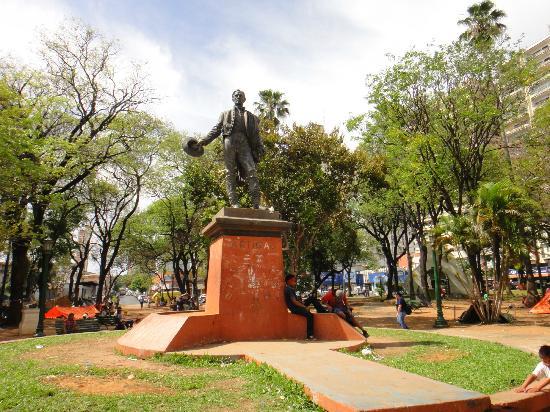
Plaza Uruguay, Asuncion
                One of the things I love most about the people in Paraguay is how friendly and open they are. Sure it takes a bit of effort to go over to someone's house, introduce yourself, and make an effort with Guarani, but the rewards of doing those little things are returned tenfold in generosity through food, terere, and social outlets. Granted I have never spent much time in Bolivia, my trip was only 13 days, but my interactions with street vendors, bus drivers, and waitresses at restaurants was far less pleasant than they have been in Paraguay. One particular instance that stands out was when I was walking the streets of La Paz with my friend Brook. The streets were overflowing with vendors selling everything from produce, to Halloween masks. Brook wanted to buy and apple and asked how much it would cost?  She said 5 Bolivianos for 5 apples in a sack, roughly $0.75. The woman also had individual apples sitting out on top of each other. When Brook said she only wanted 1 the woman refused to sell it to her not stating a reason, and continuing her conversation with the other woman sitting next to her completely ignoring us. That strange interaction manifested itself throughout the trip in many different forms. Paraguayans seemingly go out of their way to be helpful even to the point where they will tell you the wrong answer instead of saying they don’t know. Bolivians are much more inclined to ignore your question by responding in a way that isn’t quite what you asked for. A good example of that was when I was trying to get information about boarding a bus from Santa Cruz to Cochabamba. The terminal was flooded with people and I had no idea how to get on a bus. My friend Kevin was trying to deal with what we do with our bags, and I was trying to figure out where we needed to go. I walked up to a kid who worked for the bus company that we bought tickets from and ask “What platform do we need to go to get on the bus?” He looked at my ticket and answered my question by saying “Cochambaba.” I said “that is where I am going where do I go to get on the bus” His response this time was “you paid 90 Bolivianos.” After asking for the third time I finally got the answer I was looking for, but not before I got supremely frustrated by how difficult it was to get that question answered. Now I admit that my accent can be a bit strong, but it wasn’t like I was asking a complicated question. In Paraguay the response to that type of question is something like “the platform is over there” instead of going around the question. Those little subtleties are the things I picked up the most thought my travels in comparing the two countries.


La Paz
                The last and most stark contrast to me existed in the form of the public works. Both Paraguay and Bolivia have long histories, and a long list of heroes to commemorate. Both countries have monuments and statues to those heroes, but in Bolivia the public squares, parks, and statues are immaculate while in Paraguay they often look decrepit and graffiti covered. Also the number of parks and public plazas where much higher in Bolivia than Paraguay despite the fact the Bolivia is supposedly a poorer nation. That culture baffled me. I still don’t know the reason for that, and maybe never will. My instinct though led me to look at the economies of the two countries. Bolivia makes a lot of money because of its mineral resources, natural gas, and oil. Paraguay is predominately an agriculture economy with large revenues coming from selling excess power it generates from the three major dams it has. Paraguay sadly is one of the most corrupt countries in Latin America, and despite it’s revenues it seems to me that Bolivia uses its money more for social programs, public work projects, and their maintenance more effectively than Paraguay does. Bolivia is the worlds 118th ranked country in terms of corruption with Paraguay ranking 154th. While neither ranking is good it is a pretty stark contrast  that is evident in both countries public spaces.

                Having lived in Paraguay for almost a year and a half it has become a natural for me to compare it to other countries I visit in the region. My instinct told me that there would be dramatic similarities between the countries, but that instinct was wrong. Everything from the climate to the food is different, but given their small sizes, landlocked status, and poverty rankings it is easy for people to compare the two countries on paper, but the reality is far different from the statistics.