I have now been home for two months. The strange thing is that I still feel like I never left home. The routines of my parents, and the overall lifestyles of many of my friends aren't drastically different than they were before just in different settings. Yet, in spite of this seeming comfort I still find myself overwhelmed over the most random junctures of day-to-day life.
Most recently I've noticed how much our entertainment is rooted in watching stuff on our phones, TVs, or computers. I find myself captivated with all the forms of media, and the how remarkably easy it is to access anything. Thinking back to college, I remember how bonded I felt to friend groups based off of a video on YouTube, but it seems even more ubiquitous now then it did back then. Granted some of that could me own perception having been removed from an intensely wired society, but something tells me there is more to it than that. In conversations I find more and more that the substance is driven by seeing something online. It is almost as though seeing someone get hit in the crotch with a potato gun fired from a guy in a Santa Claus suit give us more substance to our lives than our day to day actions. To be honest, if I saw something like that online it might actually be the most bizarre thing I see in a day and would thus be inspired to talk about it. The problem I have with it is that I find myself constantly looking at screens because of the importance of finding relatable topics to bring up to my friends in conversation.
If I am at a bar there are at least a dozen HD TVs in the room I am in. Often times there are more. It is almost impossible to not look at the brightly colored screen especially when Sportscenter is on beating another story into the ground with their team of 65 analysts. In Paraguay, I did see young people constantly on their phones or using social media, but for the most part the art of the conversation reigned supreme. You had to carry on a discourse with another person because there were no other distractions aside from what was going on around you. The substance of those interactions were more focused on the immediate environment. The truck that blew out a tire, the mango that almost hit Juancito on the head, or the lack of a particular item in the store. People were not constantly on the move from place to place. Interaction occurred incessantly all around and that is what we talked about.
Since I've been home I notice I comment on why we as Americans do certain things the way we do. Why are bars full of big screen TV's? Why when it is -15 degrees outside does my water come with ice? Why are our my instincts when something breaks to buy a new one rather than attempt to fix it? These question plague me and constantly weigh on my mind. Everybody has something interesting to say if you really probe them about their interests, but it is easy to deflect the questions to a more light hearted YouTube clip, or the most recent episode of whatever show.
I am super guilty of this. I would read just about every night when I was in Paraguay, but now I find myself binging on books when I have time riding in a car, or waiting at doctors office rather than having some consistency. I get distracted too easily by what is on TV or the internet. I am not even saying it is a bad thing, but my social interactions are more dictated by what is popular rather than what I actually find important. If you want to sit around and watch TV all day that can be a tremendous stress reliever, but why is it everywhere I go? Are we so tired from doing our jobs and working to support ourselves that we really don't have the energy to do something active with our free time and I don't mean a regimented daily work out at the gym that is preplanned. It is almost as though spontaneity has been been eliminated from our lives. If social calendars are not planned in advance through a text or email do they even happen as much as we subconsciously want? It is weird to go up to a neighbor's doorstep and say hi without advance warning these days just to name an example.
I find myself asking questions that I never would of thought of before. Questioning even the most familiar things makes me realize how complex our lives really are. There is always something new to learn. Some social trend, app, or other piece of technology, but I find that most of these things are just tools to help us find the activities we really enjoy doing. The problem is how overwhelming that can be when all you really need to have a good time with your friends is a setting and a topic.
Monday, March 3, 2014

Monday, February 3, 2014
Crockpot Conundrum
Two nights ago I decided to make some dip for the super bowl. I got the recipe from a woman who I worked with in college,
and while it is easily the unhealthiest concoction imaginable I was pining
hard to eat it. The dish requires several bricks of Velveeta cheese, some Bob Evans
Italian Sausage, a can of cream of mushroom soup, and a jar of salsa. After
browning the sausage the ingredients are put into a Crockpot as the onlookers
are forced to wait as the room fills with the smell of artificial goodness.
The
dip turned out to be as good as I remember it, but some simple science caused
the clean up to be a bit more difficult than I could’ve imagined. Taking a
Crockpot from a cold plug and heating it up too quickly led to a bottoming out
of the removable pot. It literally cracked in a perfectly symmetrical circle
where the bottom of the pot was hung an inch above the heat source. This caused
a sticky gooey mess that sealed the broken bottom in a burnt cheesy mixture
that resembled the aftermath of a bout of food poisoning than a dip that was
just eaten.
My
immediate reaction was to throw it away, but then I thought how ridiculous that
sounded. Why in the world would I throw away a Crockpot just because a
replaceable part broke? Surely I would be able to fix it with minimal effort? I
was actually upset that my thought process immediately went towards
replacement, a more expensive but easier option, than trying to use a little
ingenuity to fix it. After all, those types of problems happened every day in
Paraguay.

Then I started to realize that maybe my initial reaction was the only option. I was disturbed at the thought that maybe trying to figure out the name of the part of the specific brand and model of the Crockpot, finding a place that sold the part in a retail store or online, paying for it and waiting for the order to be filled would probably cost more than buying a new one. I reluctantly threw it away, and am not proud to say that the action bothered me all day.
Yesterday, my mom and I went to replace it. I agreed to pay for it because I broke it and
thought that the cost would have to be higher then when we bought the original.
We went to a department store, and started to browse around. I was shocked by
how many options existed. Some had full digital monitoring system that looked
more like a satellite than a kitchen appliance. Others were so technologically
complicated that the cost tripled the amount that my mom had bought the
original for. After spending about 10-minutes looking through the options an
employee offered to help us find one using their in-store computer registry. To
my absolute amazement we found the exact same Crockpot, with an additional
smaller Crockpot that could be shipped to our house in 5 days for $10 less than
the one my mother had purchased several years earlier!
I
couldn’t believe it. I kept thinking how is this possible? How often do people
buy Crockpots that justifies such a low price? Then I thought, well, I broke
one just because of a sudden 25-degree change in temperature, so this has to
happen all the time. The overall cost of the basic model is still low enough
where the is no room to even carry replacement parts for the thing even though
Crockpot technology hasn’t really changed at all since they were invented in
the 1970s. In fact, as we were leaving my mom said that my grandmother has two
that she has had for decades, and that when I move to my own place that I could
have one of them.
I’m
convinced that all the fancy Crockpots I saw for crazy amounts of money with
all sorts of digital gadgets on them probably aren’t as reliable as the
original models that only had an on and off switch. Despite all the
technological marvels that have occurred since the Crockpot was originally
invented the models seem to be designed to fail within a 5-year period even the
ones with all the bells and whistles. A Crockpot is a nice thing to have, and
my family uses them all the time. What I cannot get over is how something that
is so technically simple can be redesigned to look nicer, with improved
materials, and work worse 40 years after its invention. I just wish I could of
found a way to fix it for the same small effort it took to get a new one.
Sunday, December 29, 2013
Beginning the Transition
In my last few days in Paraguay I had several people ask me whether or not I would continue writing in this blog after I returned back to America. To be honest, I always thought that this would end the day I left Paraguay. The whole reason for writing it was to give people insight to the work I was involved in with people in my community, and to provide some general information about a country not often thought about on a global scale. I hadn't even considered writing about the transition back mostly because those would be ramblings in America, not Paraguay. The more I thought about it, however, the more I realized that all those ramblings in Paraguay had left an indelible mark that would dramatically influence my decisions when I finally returned. While I still haven't figured out what the experience of being a Peace Corps Volunteer in Paraguay is in the long and short terms, I know that it had to of done something that overtime will hopefully become clearer in my mind.
After traveling for 3-weeks through Bolivia and Chile I left Santiago at 10:10 PM on December 19th. It wasn't until I was sitting at the gate that a flurry of emotions hit me that I had been suppressing since I had left Paraguay. Aside from the Paraguayans I would miss there were countless other people, things, and places that kept popping up in mind. Would I ever seem them again? Would I be able to go to that place in the future? When, if ever, will I go back there? Those feeling were compounded with the emotions of seeing my family for the first time in two years. I think I almost broke down on the plane several times just thinking about it all. Thankfully a women in front of me had a panic attack about the plane tacking off, and wanted to get off. Seeing that interaction, and the hundreds of movies available to watch on the touch screen TV's were enough of a distraction to get me through the first leg of my journey. When we arrived in Atlanta the phenomenon of being in America for the first time since I left in September 2011 really started to hit me. I never thought that I could be overwhelmed by a modern bathroom, but as I entered the facilities in the Atlanta airport I was taken aback by the fact that you could flush toilet paper, the facet automatically spit out hot water, and a seemingly old fashion paper towel dispenser turned out to be an automated machine that spewed the perfect amount of paper toweling to sufficiently dry my hands. I was much more used to no soap, freezing water, and minimal toweling at best, so having everything work in that efficient manner overwhelmed me a bit more than I thought possible. After braving the modernity of the bathroom I started heading for my gate, and was exposed to American morning television programming for the first time since I left.
As most morning shows go, this one was a myriad of pop culture trash stories intertwined with national and international news. There was a two minute bit on some guy saying racist comments from this super popular television show that I had only heard of in passing called Duck Dynasty. Then there was a 30 second update on the brewing civil war in South Sudan followed by a three minute breaking news piece about a theatre in London collapsing during a performance where nobody died. I understood that news is meant to appeal to the people watching it, but having come from a place that was lower down the development scale I was saddened by what my country saw was important information. That's not to say this particular news program was most well informed show on TV, but it being my first exposure to American media it was a bit overwhelming.
When I finally saw my parents for the first time the emotions finally boiled over, and it hit me that I wasn't going back to Paraguay. Seeing the city where I grew up for the first time since I left was pretty incredible. Cincinnati has gone through numerous development projects since I left. There are all sorts of new apartments, bars and restaurants in several areas where there was previously nothing. There is a large casino in the middle of downtown. Houses and buildings that I passed on a daily basis growing up are sometimes different colors. Supermarkets, bars, restaurants, and stores have more choices than I could imagine, and I have often found myself getting overwhelmed by those choices. All technology seems to be put in place to simply to make things happen faster like having your check split without even asking. I was so used to struggling through who owes what when the bill comes that I sort of missed the incipient banter that inevitably followed resolving the check. In Paraguay, if I found a stout beer I would literally scream out loud. In America, every bar has at least four choices all which are slightly different. The way we interact with people is also remarkable.
The way we as Americans interact with each other is peculiar to me now, and I finally understand why Paraguayans thought I was so strange on some levels. We have this instinctual ability to ask extremely directed questions at each other. To me, it seems more like a mechanical process to produce the desired result as quickly as possible. Drawing out emotions in conversations that are meaningful is a talent that not many of us process. Since I've been home, granted its been a week, the first time I see people that I haven't spoken to since I left they ask my two questions in this order: "How was it?" and "What are you going to do next?" It's not rude, its just how we interact. The questions are general enough that I could ramble for hours, but instincts tell me that I have to have a short an concise answer. Before we left Paraguay we had a closing of service conference that had a secession about transitioning home. In that time we discussed elevator speeches in which we gave a five minute summery of a good story, a challenge, and a funny story from our service. I, for whatever reason, haven't quite figured out the perfect way to tell that story, but I have a lifetime to figure it out. I hear all the time that people don't care about what you did, and that the hardest part of transition is that seeming lack caring, but I don't think it's that simple. It's not that people don't care I think it's more they don't have the capacity to understand in that moment. I view it as my responsibility to get them to care, to show them that this something meaningful to me and that if you're willing to listen it can have some semblance of the same meaning to you. It's getting to that conversation that has been the hard part because those two years that I spent in Paraguay were two years that other people spent doing interesting things as well that could've been as meaningful if not more to their lives as my experience was to mine. The conversation is reciprocal, and it is a skill to be able to illustrate how my experience relates to others. This has been a crazy week and I am still figuring out what it means to be home again. All I know at this point is that things seem eerily the same, but strangely different and recognizing the differences has actually been quite fun so far.
After traveling for 3-weeks through Bolivia and Chile I left Santiago at 10:10 PM on December 19th. It wasn't until I was sitting at the gate that a flurry of emotions hit me that I had been suppressing since I had left Paraguay. Aside from the Paraguayans I would miss there were countless other people, things, and places that kept popping up in mind. Would I ever seem them again? Would I be able to go to that place in the future? When, if ever, will I go back there? Those feeling were compounded with the emotions of seeing my family for the first time in two years. I think I almost broke down on the plane several times just thinking about it all. Thankfully a women in front of me had a panic attack about the plane tacking off, and wanted to get off. Seeing that interaction, and the hundreds of movies available to watch on the touch screen TV's were enough of a distraction to get me through the first leg of my journey. When we arrived in Atlanta the phenomenon of being in America for the first time since I left in September 2011 really started to hit me. I never thought that I could be overwhelmed by a modern bathroom, but as I entered the facilities in the Atlanta airport I was taken aback by the fact that you could flush toilet paper, the facet automatically spit out hot water, and a seemingly old fashion paper towel dispenser turned out to be an automated machine that spewed the perfect amount of paper toweling to sufficiently dry my hands. I was much more used to no soap, freezing water, and minimal toweling at best, so having everything work in that efficient manner overwhelmed me a bit more than I thought possible. After braving the modernity of the bathroom I started heading for my gate, and was exposed to American morning television programming for the first time since I left.
As most morning shows go, this one was a myriad of pop culture trash stories intertwined with national and international news. There was a two minute bit on some guy saying racist comments from this super popular television show that I had only heard of in passing called Duck Dynasty. Then there was a 30 second update on the brewing civil war in South Sudan followed by a three minute breaking news piece about a theatre in London collapsing during a performance where nobody died. I understood that news is meant to appeal to the people watching it, but having come from a place that was lower down the development scale I was saddened by what my country saw was important information. That's not to say this particular news program was most well informed show on TV, but it being my first exposure to American media it was a bit overwhelming.
When I finally saw my parents for the first time the emotions finally boiled over, and it hit me that I wasn't going back to Paraguay. Seeing the city where I grew up for the first time since I left was pretty incredible. Cincinnati has gone through numerous development projects since I left. There are all sorts of new apartments, bars and restaurants in several areas where there was previously nothing. There is a large casino in the middle of downtown. Houses and buildings that I passed on a daily basis growing up are sometimes different colors. Supermarkets, bars, restaurants, and stores have more choices than I could imagine, and I have often found myself getting overwhelmed by those choices. All technology seems to be put in place to simply to make things happen faster like having your check split without even asking. I was so used to struggling through who owes what when the bill comes that I sort of missed the incipient banter that inevitably followed resolving the check. In Paraguay, if I found a stout beer I would literally scream out loud. In America, every bar has at least four choices all which are slightly different. The way we interact with people is also remarkable.
The way we as Americans interact with each other is peculiar to me now, and I finally understand why Paraguayans thought I was so strange on some levels. We have this instinctual ability to ask extremely directed questions at each other. To me, it seems more like a mechanical process to produce the desired result as quickly as possible. Drawing out emotions in conversations that are meaningful is a talent that not many of us process. Since I've been home, granted its been a week, the first time I see people that I haven't spoken to since I left they ask my two questions in this order: "How was it?" and "What are you going to do next?" It's not rude, its just how we interact. The questions are general enough that I could ramble for hours, but instincts tell me that I have to have a short an concise answer. Before we left Paraguay we had a closing of service conference that had a secession about transitioning home. In that time we discussed elevator speeches in which we gave a five minute summery of a good story, a challenge, and a funny story from our service. I, for whatever reason, haven't quite figured out the perfect way to tell that story, but I have a lifetime to figure it out. I hear all the time that people don't care about what you did, and that the hardest part of transition is that seeming lack caring, but I don't think it's that simple. It's not that people don't care I think it's more they don't have the capacity to understand in that moment. I view it as my responsibility to get them to care, to show them that this something meaningful to me and that if you're willing to listen it can have some semblance of the same meaning to you. It's getting to that conversation that has been the hard part because those two years that I spent in Paraguay were two years that other people spent doing interesting things as well that could've been as meaningful if not more to their lives as my experience was to mine. The conversation is reciprocal, and it is a skill to be able to illustrate how my experience relates to others. This has been a crazy week and I am still figuring out what it means to be home again. All I know at this point is that things seem eerily the same, but strangely different and recognizing the differences has actually been quite fun so far.
Tuesday, November 26, 2013
Saying Goodbye...Again
Well as hard as it is to believe,
my two years of Peace Corps service have been completed, and I have to admit
that it really hasn’t hit me that I am leaving tonight. Packing up and saying
goodbye constantly for seemingly about a month has taken a pretty big toll
emotionally. Couple those feelings with the inevitable challenges with dramatic
transition, and you got yourself a big mess when trying to wrap things up and
finally say goodbye for now to a lot of people who I have come to care
about. I had a very positive
experience in Paraguay and the adage you learn more from the people you’ve come
to help than you teach them certainly seems true at this juncture.
I
like to think that I used this blog primarily so people at home could see what
I was doing, and how I was living. The more I wrote about in it the more I
noticed a change in style from short anecdotes to larger themes about the
culture, economy, and Paraguay in international contexts. Those small projects
that I found myself involved tremendously enhanced my understanding of Paraguay
in the larger contexts, and a better fostered personal understanding of how the
country functions. Paraguay is a small poor country. The division of wealth is
astronomically skewed, and the tides of globalization where omnipresent and
incessantly expanding in the two short years I was here. I saw one President
get overthrown, and another get elected in. I sat in on community meetings, and
read a lot about Paraguay’s government and history. The spectrum of my
experience is truly remarkable, and it kept me guessing at every juncture.
Despite all the challenges this country still faces it still somehow manages to
leave an indelible mark on the psyche of the people who spend time here, and I
marvel at how happy people are despite not having many things I would’ve deemed
essential before my arrival. A truly happy life isn’t one that is defined by
material processions or individual achievements, but rather by the people you
choose to share it with. If I have learned anything in my two years it how
essential relationships are in making us complete human beings. I truly believe
that if you surround yourself with loved ones who share common interests and
help each other out than the path to a beautiful life has already been
discovered. Time truly flies when you’re the happiest, and for me these two
years went by in a breeze.
My
plan is to continue writing as in this blog as I travel and transition back to
the states, but I wanted to thank everyone who took the time to read even one
entry. I found this blog to be a respite in a sometimes hectic lifestyle, and I
truly appreciate the support and kind words I have received concerning my
writing. Look for a new entry when I get back to the states on December 20th,
so until then suerte!
Friday, November 1, 2013
Eco-Brick Bench
 Introducing new ideas, or projects
in a community is very difficult. There are so many facets that determine whether
or not something is going to be successful that there is no clear indicator of
how something is going to work until you try it. A good example of this is seen
in the usage and production of ecological-bricks. What makes them an
interesting example is that they are a relatively new idea in Paraguay, but
their creations taps into a common cultural norm of reutilizing things.
Paraguayans are constantly finding ways to reuse things that I would consider
garbage. Got rotting boards in your house? No problem, use them to make a
fence. Some shelf or door break? Get some small gage wire and rig it back up.
I've even seen people deconstruct their house piece by piece only to rebuild it
somewhere else. A lot of this has to do with cost and availability of
materials, and yes while many things are no ubiquitous, the decades of
self-reliance still prioritizes reusing stuff as much stuff as you possibly
can.
Introducing new ideas, or projects
in a community is very difficult. There are so many facets that determine whether
or not something is going to be successful that there is no clear indicator of
how something is going to work until you try it. A good example of this is seen
in the usage and production of ecological-bricks. What makes them an
interesting example is that they are a relatively new idea in Paraguay, but
their creations taps into a common cultural norm of reutilizing things.
Paraguayans are constantly finding ways to reuse things that I would consider
garbage. Got rotting boards in your house? No problem, use them to make a
fence. Some shelf or door break? Get some small gage wire and rig it back up.
I've even seen people deconstruct their house piece by piece only to rebuild it
somewhere else. A lot of this has to do with cost and availability of
materials, and yes while many things are no ubiquitous, the decades of
self-reliance still prioritizes reusing stuff as much stuff as you possibly
can. Eco-bricks
are pretty simple to make. Basically you fill plastic bottles with plastic
bags, wrappers, or paper products until the bottle is densely packed to the
point of being hard as brick. Given the rise of plastics, especially grocery
bags, soda bottles, and candy wrappers, there is a plethora of these materials
all over Paraguay. The sheer amount greatly contributes to the growing problem
with trash management not just Paraguay, but many other developing countries.
With growing accessibility to things like plastic bottle cokes, and Nestle
candy wrappers a there is a big spike in the amount of garbage individual
families produce that is compounded across the country. It is amazing how much
trash I produce individually. It used to be that I could fill a bag of garbage per
week, but ever since I started making eco-bricks, my trash productions have
been halved. Over the course of nine months I filled ten bricks. The school was
able to make 49 from leftover garbage, papers, and trash thrown in the streets
in just three weeks. In short these bricks are not only effective, but also
easy to make and free to produce.
Eco-bricks
are pretty simple to make. Basically you fill plastic bottles with plastic
bags, wrappers, or paper products until the bottle is densely packed to the
point of being hard as brick. Given the rise of plastics, especially grocery
bags, soda bottles, and candy wrappers, there is a plethora of these materials
all over Paraguay. The sheer amount greatly contributes to the growing problem
with trash management not just Paraguay, but many other developing countries.
With growing accessibility to things like plastic bottle cokes, and Nestle
candy wrappers a there is a big spike in the amount of garbage individual
families produce that is compounded across the country. It is amazing how much
trash I produce individually. It used to be that I could fill a bag of garbage per
week, but ever since I started making eco-bricks, my trash productions have
been halved. Over the course of nine months I filled ten bricks. The school was
able to make 49 from leftover garbage, papers, and trash thrown in the streets
in just three weeks. In short these bricks are not only effective, but also
easy to make and free to produce.
The
idea originated from Guatemala where an environmental NGO started, recognizing
the rising costs of building materials and the ever-growing multitudes of
trash, started filling up empty plastic bottles to use in building schools,
benches, and other small buildings (http://en.wikipedia.org/wiki/Eco-brick). By
layering the bricks, setting them in wire fencing, and coating them in cement
you get yourself a pretty stable small structure. The costs are virtually
nothing, helps reduce waste production, and cleans the streets. There is,
however, some debate concerning the structural integrity of the bricks. If they
are not densely packed then they're susceptible to crumbling. Obviously the
solution is to make sure they are all in good shape before hand, but when doing
this with children you're dealing with attention spans that can be shifted at
the drop a hat. While from what I've seen, kids are very enthusiastic to fill
up the bottles, but less inclined to pack them to capacity. Nevertheless, given
the plan at the school next to my house was to build a small bench; we could
overlook a lot of these less than ideal full bricks.


The
most basic design Peace Corps Paraguay has developed requires 28 bricks, a bag
of cement, and about 20 regular bricks. You can buy a regular brick for a
nickel, but cement costs about $12 per 120 lbs bag. That is a bit pricy, but
still not over the top expensive. Bricks made in Paraguay are not that much
different then bricks made anywhere else. Heavy clay soils are mixed with some
chemicals, dried, and baked in a giant kiln. The problem is how fragile they
are. The cheapest bricks will break if they fall from a height of a foot. It is
a very labor-intensive process that has to be done with care. Eco-bricks, while
useful, do still need to be flanked by regular bricks so they structure can
better hold its form. In our case we decided to make a small 28 eco-brick
bench, so setting the structure in wire before hand wasn't super important but
building a support structure was.

 When
I got to the school the day we were to build the benches we picked out a
location and began digging a small trench to layer normal bricks as the foundation.
We then mixed cement and started building up the bench with four layers of
eco-bricks of seven across with regular bricks on the flanks. We decided to
leave one side of the bench open to better demonstrate what we did. I left the
morning classes feeling good what we accomplished. In the afternoon I thought
all we would have to do is smooth out the cement, and fill in a few holes. When
I sauntered up to the school in the afternoon, however, I saw that all students
were there filling more eco-bricks with the teachers. I was informed that the
bench was off center, and they wanted to extend it. I was thrilled by the enthusiasm,
and quickly started digging the extension. After several hours, and 31 eco
bricks later, we had our bench. We determined that having the top layer of
regular bricks is a more effective way to encase the eco-bricks, and it made for
a more stable seat. Ironically the extension made the bench more off center
than before, but the teachers seemed thrilled.
When
I got to the school the day we were to build the benches we picked out a
location and began digging a small trench to layer normal bricks as the foundation.
We then mixed cement and started building up the bench with four layers of
eco-bricks of seven across with regular bricks on the flanks. We decided to
leave one side of the bench open to better demonstrate what we did. I left the
morning classes feeling good what we accomplished. In the afternoon I thought
all we would have to do is smooth out the cement, and fill in a few holes. When
I sauntered up to the school in the afternoon, however, I saw that all students
were there filling more eco-bricks with the teachers. I was informed that the
bench was off center, and they wanted to extend it. I was thrilled by the enthusiasm,
and quickly started digging the extension. After several hours, and 31 eco
bricks later, we had our bench. We determined that having the top layer of
regular bricks is a more effective way to encase the eco-bricks, and it made for
a more stable seat. Ironically the extension made the bench more off center
than before, but the teachers seemed thrilled.
 I
have no idea whether the eco-brick bench will lead to construction of similar
things in the community. What I do know is that this new idea inspired the
students and teachers to work independently of me in finishing up a project I
helped educate them about. It not only temporarily reduced the trash
consumption of the school, but also added a new place to sit for virtually
nothing. I don't see Paraguay consuming fewer plastics in the future, which
leads me to believe that this type of project will continue to have legs moving
forward. Paraguayans have an
inherent comprehension of how to build things and how to reutilize things.
Tapping into those engrained cultural norms can be a very powerful tool in
introducing new ideas no how big or small.
I
have no idea whether the eco-brick bench will lead to construction of similar
things in the community. What I do know is that this new idea inspired the
students and teachers to work independently of me in finishing up a project I
helped educate them about. It not only temporarily reduced the trash
consumption of the school, but also added a new place to sit for virtually
nothing. I don't see Paraguay consuming fewer plastics in the future, which
leads me to believe that this type of project will continue to have legs moving
forward. Paraguayans have an
inherent comprehension of how to build things and how to reutilize things.
Tapping into those engrained cultural norms can be a very powerful tool in
introducing new ideas no how big or small.Thursday, October 10, 2013
Monday Street and Traffic
I spend a lot of time walking down
long dusty roads. Approximately 15% (http://data.worldbank.org/indicator/IS.ROD.PAVE.ZS)
of roads in Paraguay are paved. The vast majority of the paved roads are in the
major cities, and the principal highways connecting those urban centers
together. The number of paved roads has been steadily increasing for decades,
but progress is still slow. A big part of the reason progress is so slow is the
process of paving the roads themselves. I'm hardly an expert on how roads are
constructed, but I am fairly confident that the method utilized here is a far cry from the standard in a more developed nation.
 |
| Monday Street is about 30 yards from my house |
 The
problem, however, is that getting a road paving machine is easier said than
done. There are finite amount in Paraguay, and you got to have the political
capital to get one, especially if you live far away from the major cities. Four
months ago, O'Leary obtained one of these machines, and paved five roads in the
center of town that had been cobbled years ago. Over the course of a week, most
of the principal streets were paved, but the town still has a ton of cobbled
and dirt roads interspersed throughout. I have to admit that overall, I was
very impressed by the new paved roads. To promote the completion of the roads
the Municipality hosted a bicycle race around the freshly asphalted streets, a
task that would've been much more difficult on the male anatomy just a few
months before. People seemed pleased by the roads, and despite my last place
finish in the race, I could tell this was a positive step in the development of
the town. Despite taking years to complete, it was nice to see the town
progress in that way, but there are many consequences that I initially
overlooked when considering the benefits of the new roads.
The
problem, however, is that getting a road paving machine is easier said than
done. There are finite amount in Paraguay, and you got to have the political
capital to get one, especially if you live far away from the major cities. Four
months ago, O'Leary obtained one of these machines, and paved five roads in the
center of town that had been cobbled years ago. Over the course of a week, most
of the principal streets were paved, but the town still has a ton of cobbled
and dirt roads interspersed throughout. I have to admit that overall, I was
very impressed by the new paved roads. To promote the completion of the roads
the Municipality hosted a bicycle race around the freshly asphalted streets, a
task that would've been much more difficult on the male anatomy just a few
months before. People seemed pleased by the roads, and despite my last place
finish in the race, I could tell this was a positive step in the development of
the town. Despite taking years to complete, it was nice to see the town
progress in that way, but there are many consequences that I initially
overlooked when considering the benefits of the new roads. |
| Plants covered in dust layer |
If
they issue a citation it’s likely that the guilty party cannot afford to pay
the fine, and would simply discard the ticket as soon as the cop left. The
judicial system is very rigidly structured, and lacks the efficiency and
capacity to process a high volume of traffic violations. In essence the amount
of resources and effort it would take to effectively enforce traffic laws would
overwhelm the institutions relegated to deal with the laws. It is far easier to
turn a blind eye to the problems then deal with the upheaval associated with
strict enforcement. Disregarding minor traffic violations frees up the police
and courts to focus on bigger issues. That being said, there is no way this
country can continue to ignore this endemic problem with traffic safety.
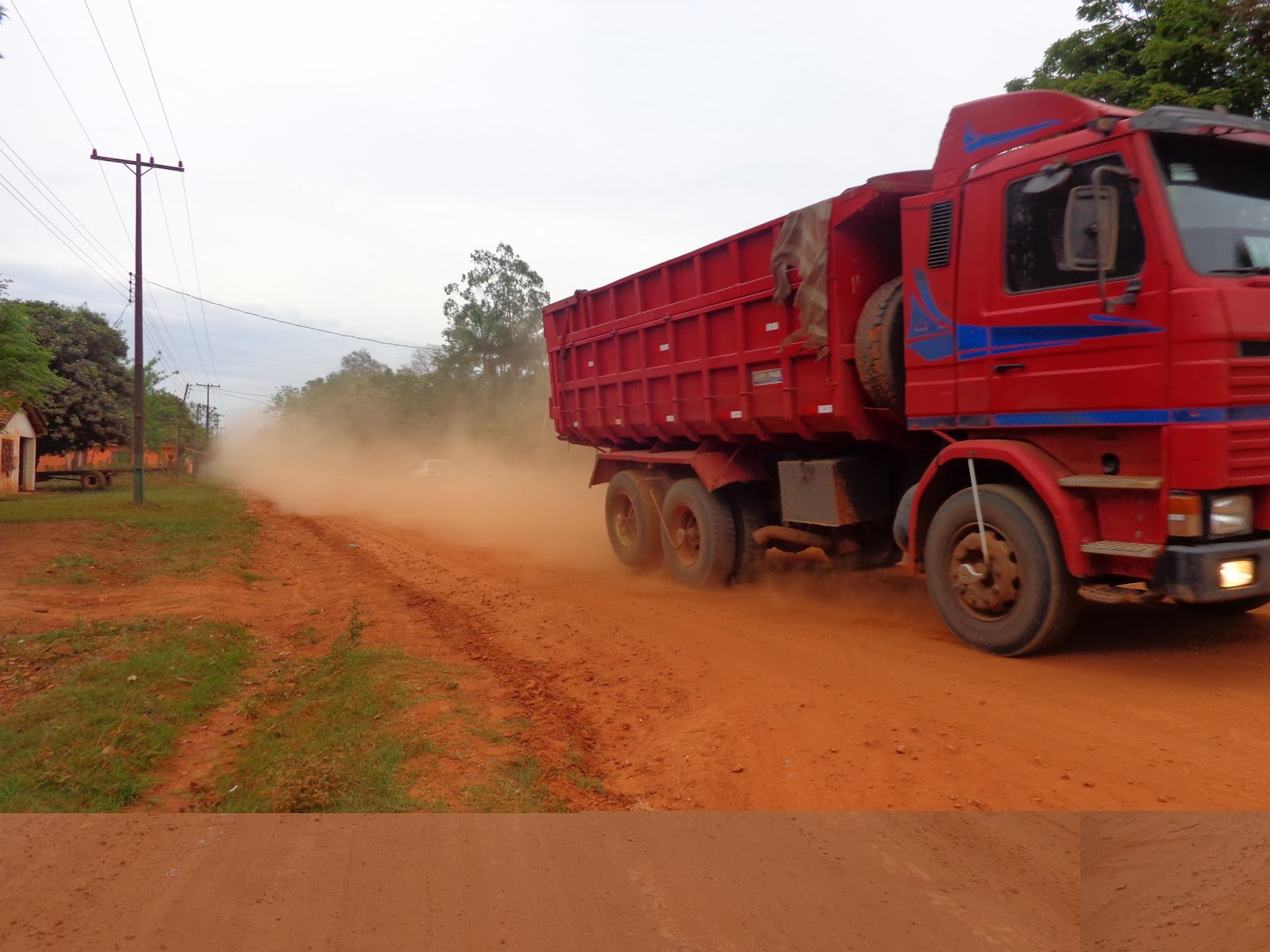 |
| Truck kicking up dust |
Paraguay
is not going to stop building roads, and as the population continues to grow so
will the number of motor vehicle accidents, thus necessitating the need for a
comprehensive traffic safety system. A few months ago a group of volunteers and
I did a tour of Itaipu Dam. On our tour were a British woman and her husband.
Naturally we were all surprised to see this couple in Paraguay. When we asked
why she was here she responded that she had been coming frequently for 20 years
trying to assess the need to a traffic safety system. When she first came
20-years ago there was no need whatsoever, but now with rapidly growing
population and the dramatic influx of motorcycles she said that she couldn't
justify not implementing a modern traffic safety system. What is most
remarkable is how despite the growing need for such a system how few roads are still
paved.
It
think it is obvious to say that paved roads lead to faster speeds, and more
accidents therefore necessitating infrastructural improvements for traffic
safety, but 85% of all roads are still unpaved. The number of paved roads has
increased at snails pace since the 1980s, but the number of vehicles has
increased tenfold. Even the poorest of families can take out a loan for a
motorcycle and pay monthly quotas at insane interest rates. Repossession for
non-payments can take months, so it is not uncommon to see families with two or
three motorcycles. Many of these poorer families live on the extremities of
cities, towns, and in the countryside where paved roads don't exist. The
ever-increasing amount of vehicle traffic in these dirt road communities leads
to a plethora of other problems including dust erosion.
 |
| Dust cloud |
I
live 2 KM away from a principal highway on a street called Monday (mun-da-u).
The street is a dirt highway that goes 88 KM into the countryside before
hooking left for another 45 KM until you get to another paved road. Due to its
length, it is heavily trafficked by trucks carrying agricultural products from
communities in the interior, personal cars, and motorcycles. The amount of
traffic coupled with the importance of the road makes Monday Street a veritable
quagmire of mud and dirt. When it rains the road is virtually impassible even
on foot. The clay heavy soil, the lack of trees, and the hilly topography leads
to countless accidents. Trucks get stuck; people slip, and the road stays that
way for days. When it is dry, the vehicle traffic kicks up enormous amounts of
dust that coats everything. I get made fun of all the time for having dirty
cloths by people outside O'Leary. I kindly explain to those hecklers that if
they come visit me they'll find out why. All my white cloths now have a
reddish-brown hue to them, which is nice if all your dress socks are dirty, but
not in any other situation. People's houses are covered in dirt and the
vegetation has a nice layer of brown covering anything within a marginal
distance from the road. The worst part about it is how common this situation is
throughout the country. Although, I'll admit that Monday is one of the most
trafficked paved roads I have heard of in Paraguay.
It
is easy to complain about the mud and dirt, and trust me I can do that for
hours, but what is really scary is that in spite of the fact that the road is
unpaved, vehicles still bolt down this road at excessive speeds. In some cases,
families live 10 feet from this road, and while these is a side path, it eventually
ends so you are more often than not walking on the street itself. I am
absolutely amazed that I don't hear of more instances of people getting into
accidents on this road. The number of children I see riding motorcycles loaded
with stuff from a store, or with multiple people on board weaving between this
heavy traffic is staggering. People complain, myself included, that they need
to pave the road, and I agree the respiration and general health issues
associated with inhaling a ton of dust is of the utmost importance, but is a
paved road a better option given the frequency of motor vehicle accidents in
Paraguay? If the assumption is that paved roads lead to faster traffic than
paving Monday would theoretically lead to more accidents. I have no idea
whether that factors into the reasons why the road is not going to paved
anytime soon, but I think it should be.
As
with any developing country safety standards seem to develop after the creation
of the danger. The brutality of motor vehicle accidents in the States led to
the creation of laws that improved vehicle safety standards, more stringent law
enforcement, and a more safety conscience population. Does that mean the same
sort of things will happen in Paraguay? Ironically motor vehicle safety laws in
Paraguay are in some ways more extensive than in the USA, but lack
infrastructure and enforcement. I think it goes beyond that though. I've notice
through my interactions with people that death is something that is intensely
grieved for a short period of time, and rarely brought up again afterwards. You
are hard pressed to find someone in Paraguay that doesn't know someone who died
or was in a serious motorcycle accident. Despite all that death and suffering countless
families have endured at the hands of a traffic accident nothing seems to
change. People aren't mobilizing to demand better traffic standards. They don't
seem to change their own habits either. It's one of those things that is
seemingly just accepted a part of life that we all must live with. An expression
that people use on a daily basis here is "así es" meaning it is what
it is, or quite so. It breaks my heart that sentiment exists in place where so
many have suffered losses that might of been prevented, but what hurts the most
is I don't see any sign that things will change. I believe there will never bee
a massive campaign to remedy this problem that is causing so much death in this
country. It's just not the way things work here. I truly hope I am wrong and
that over time people will stop accepting this as normal part of their
existence, but I sadly don't see it changing anytime soon.
Thursday, September 26, 2013
Personifying Pumps
 |
| Top of the well |
When
I first arrived in O'Leary on that sweltering day in December, I distinctly
remember taking a shower. I didn't take another one for 2.5 months after that
first day. Why you ask? Because we were in the midst of a pretty severe
drought, and there was no water. Julio and Iris, my host parents in O'Leary,
happened to be on the municipal water supply system, but where they live is on
the extreme end of the supply chain meaning that their water would be the first to stop flowing so as to meet the demand of increased usage in the center of town. For me never
having lived in a home where running water wasn't readily available, it was a
bit of a transition. The water would run from about 1-5 am during those first
few months. That meant the toilet tank would have one flush in the morning for
the 6 of us in the house. When there was no water I couldn't flush the toilet
at all. After a couple of weeks I swallowed my pride and asked Mathias, my host
brother, how to the flush the toilet? He looked at me with befuddlement and told
me all I needed to do was fill up a bucket and pour it in the bowl after I had
done my business. I felt pretty stupid after that, but it was just one of many
things I was unaccustomed to. For that family the water going out happened all
the time, and I am sure installing a modern bathroom for the family was pretty
big deal that didn't happen that long ago. As time went on, I got used to life
without a lot water, but the drought kept getting worse.
 |
| Metal Bars |
When
the prospect of living on my own came up a few months later, I was told they
could put in a water tank for me. The house I was going to move into, didn't
have a connection to municipal water, and left me with a choice. Do I spend the
money to put in running water, or do I fix up the well so I can pull up water
myself? The cost difference was pretty significant, but I decided to go with
the pump. Four pumps later I sit hear telling you that maybe I should of not gone
the cheaper route. Little did I know at that time how much those pumps would
impact my life and teach me more about perseverance than I could've ever expected.
 |
| Tank on top of my house about 20 yards from the well |
Auger
was like that mid-life crisis Ferrari. He was shiny, was seemingly the solution
to all my problems, and ran smoother than a slip and slide covered in vegetable
oil. Julio helped me install him, and from day one we were in love. Powerful,
consistent, and fast he could fill my tank in 8 minutes 27 seconds flat without
breaking a sweat. Life was good with Auger. His name derives from the brand of the pump. The only problem with Auger was that he was expensive, and I
unwisely didn't take out insurance. In mid-April I returned from being away for
a few days, and flipped on the switch to see if Auger was working his magic. I
heard absolutely nothing, and ran outside only to discover that he was gone. I let out an enraged wail with a fury that I didn't know I possessed, and realized that he was gone
forever. He was like that promising rookie who had a career ending injury half
way through the season. It took me a long time to get over him, but after two months of pulling buckets of water by hand I gotten fed up and decided it was
time to move on.
Luck
was just around the corner. A fellow Peace Corps Volunteer heard my of plight, and
mentioned he had a pump, never before used, that he was willing to sell for
cheap. He was like the test-drive sedan, functional, but never fully tested. His
name was CJ Bomba because like Auger that was the name typed in bold lettering on the box. CJ had to wait around my house for a while as I provided extra
security for him. This involved getting one of my friends to come over and help
me install a metal cage top for my well, so the pump couldn't be so easily taken. I had
learned my lesson from Auger, and was taking extensive precautions with CJ. My
friend and I built the metal top by placing the metal cage it on the top layer of the existing bricks
that made up the highest part of the well. We then cemented a new layer on top, and we were in business. We
then took CJ out and put him in the well, and locked the cage. CJ worked well
enough, but would time and again not pump water. I thought it was similar to the problem Frank had, but couldn't understand his inconsistency. Over time he
stopped working all together. I thought it had to do with my electrical
connection, but that wasn't the case. Turns out he was broken, and needed a
replacement part. It was a cheap fix, but I needed some help putting him back
in the well. Julio is as elusive as Bigfoot whenever I need his help, so one
day I got tired of waiting decided to do it myself. I wired CJ, connected him to the tubing, and
lowered him into the well. Having little to no experience in installing the pumps
myself I was skeptical that I would get it to work. I held my breath as I
flipped the switch on and sure enough I heard the sweet sound of water flowing
into my tank. I literally jumped in the air with a fist raised in triumph when
I heard that sweet sound water flowing out of the tube. The only problem was I had to reattach my tubing to my
water tank, which I had taken down at the onset of CJ's problems. The next day
I borrowed a rickety ladder, and put the tube back in the tank. I managed to
break one the ladder rungs on the way down, but thankfully avoided injury. I
was beaming with pride at my self-reliance. I was so smug about my accomplishments
that I went about telling everyone how I installed CJ myself without help. The Paraguayans
I talked to munificently praised me, but I knew full well that they thought I
was an idiot for not knowing how to do it in the first place. Shortly after installing the
tubing, however, I realized that water wasn't flowing. I had leave that day for
a meeting, but figured it was the electricity again and left without a second
thought that the problem might be more complicated.
 |
| Vantage point from below |
Learning
the harsh lessons from CJ humbled me significantly when installing Hiper, again named for what it said on his packaging. He may not be the fastest, or the best but he serves his purpose and I made sure I put him
in the well correctly. Personifying these pumps is really the best way to describe the
tragedy that befell them. One broke, one was stolen, and one sank to the
bottom. In each instance I learned something about pumps that I didn't know
before. In each instance I made effort to rectify the mistakes I had made with
their predecessor. I am not totally sure what this says about my Peace Corps
service, but I think that the process of resolving the problems with the pumps
is a nice representation of the day-to-day challenges that pop up out of
nowhere. It is easy to point to language, cultural differences, and food as the
things that are most difficult to deal with, but there are so many other
unexpected challenges that often times prove to be the biggest learning
experiences. Things like getting your haircut, flushing a toilet, buying tools
or specific materials, and transportation are just a few examples of those
unexpected challenges. The situations I have had with my pumps have easily been
one of the biggest tests I've faced. Do I wish that I never had to deal with these pumps in the fist place? You better believe it, but the fact remains that it happened
and I have a lot of stories to tell that I'm sure will be funny to me
someday. Maybe.
Subscribe to:
Posts (Atom)