Search This Blog

Tuesday, September 10, 2013

Brazil

Iguaçu Falls
Iguaçu Falls
      It took me close to two years, and despite living a mere hour and a half from the border I finally made it to Brazil, and it was awesome! I took my last 11 vacation days and spent them visiting Iguaçu Falls in Foz do Iguaçu with my life long friend Kit, and then onto Rio De Janiero to spend a week with four other friends from back home. Thanks again, Hervas, Bohlke, Sam, and Haley for your visit. I could probably write an entire book about my time in Brazil, but I figure that thousands of people have already done that in one form or another given the touristy nature of the places I visited. All I'll say is that Rio was one of the coolest place I have been and certainly one of best cities, so put it on your list of places to go it it isn't already. I was struck by so many things when I was in Brazil, but think what struck me the most was how little I knew about it. Brazil is the 5th largest country on earth in both population and area. It has a lot of diversity, contains some of the worlds most unique ecological wonders, and still has parts that are widely unexplored. It amazes me that despite all it has to offer I could only think of a few things I knew to be Brazilian before my trip including, samba, carnival, the beaches, Christ the Redeemer statue, the flavelas (slums), and soccer. Maybe that is more than most people, but it struck me as pathetic given the size and global influence Brazil has.

       I spent a long time trying to figure out why I knew so little about Brazil. I think a lot of it has to do with the language. Portuguese is the 6th most spoken language on earth with a total of 258,604,956 speakers in 9 countries that recognize it as an official language. Of that number 201,009,622 live in Brazil for staggering 77.7% of the total (http://en.wikipedia.org/wiki/Portuguese_language). This is a language that has roots in small European country of 16,000,000 people. By comparison America has the worlds largest population of English speakers with 58.5 of the world total (http://en.wikipedia.org/wiki/English_language). The difference, though, is while English is the most commonly learned second language, Portuguese is rarely promoted as an important language to learn. That mentality is likely changing given Brazil growing economy, but regardless if it wasn't for Brazil there wouldn't be much point in learning Portuguese as second language. It be like learning a Scandinavian language, cool that you can speak it, but limited in its usage. What is even more staggering is the fact that the total population of South America is roughly 399,230,000 people meaning that slightly more that half of all South Americans are Brazilians. When I hear South America mentioned, I immediately think Spanish, but even though nine countries speak Spanish in South America, compared to one that speaks Portuguese, that one country has more people then the rest combined.
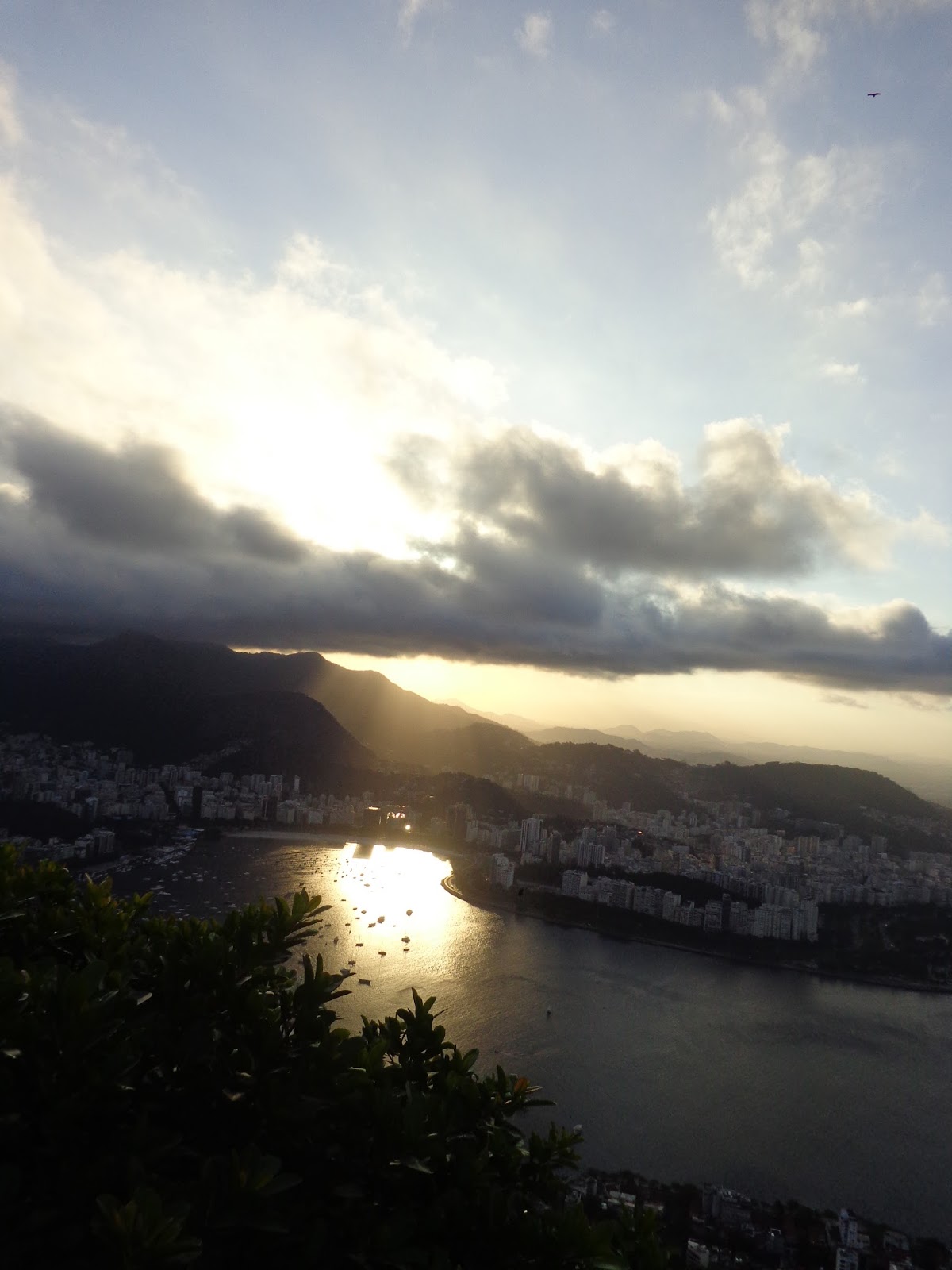
View from Sugar Loaf

       While Spanish and Portuguese are both romance languages that there roots in neighboring European countries, they are different enough that someone who speaks Spanish would struggle in Brazil and vice versa. I remember meeting a few Brazilians in Uruguay when I was there last Christmas. I was better off speaking English to most of them, which is even more dissimilar, than trying Spanish. Even in Rio, I found English was more commonly spoken than Spanish, and I was frequently amazed when cab drivers would stop me and speak English after trying to Portuguese up my Spanish. Reading wise it is really similar with some words being completely different, but enough cross over to figure out the gist if you speak Spanish. What amazes me even more how the borders of Brazil and other countries seem to be a wall against language learning. The second I entered Brazil my Spanish became useless. The same can be said about Portuguese when I crossed back over to Paraguay. Most people I have met who claim to speak both really don't speak both, but rather have tendencies one way or the other while with certain words being switched in appropriate places.
View from Sugar Loaf
      Culturally, I noticed a lot of similarities between Brazil and other South American countries. The outdoor restaurants, coffee, general lay out of the cities, and a smattering of old looking buildings from colonial times were as prominent they are in other cities, but it still had a very different feel. Maybe it was because I was in Rio while they're preparing for not only the World Cup next year but also the Olympics in 2016, but it felt a lot more modern to me than other South American cities. What struck me about Buenos Aires, Montevideo, and Lima when I went there was how the modern buildings and amenities were hidden within the frame work of an old looking city. Rio struck me with a more balanced look with lots of modern looking buildings and infrastructure taking prominent positions within the backdrop of the city. It seems clear that Brazil is on the up and up, but unlike other countries that have experienced rapid development in recent decades the vibe seemed much more laid back. When I was in China, things were moving at a frantic pace to keep up with the economy. As a result the environment suffered, and at times has rattled the social framework of the country. Brazil is an economic powerhouse, but despite all it has, it doesn't seem to be growing too fast for society to keep up. Its development seems to be a much more calculated design within preexisting the social framework than other places I've been.
       It was clear to me that the country had wealth, but what was fascinating was how little it seemed to effect the the social interactions between people. All shapes, sizes and colors came off as equals even though that is not the case at all. I somehow felt that the people in Rio despite being in a major city came off as being a part of a community. A lot of that might have to do with the various neighborhoods within the city that have distinct culture identities, but I constantly had the feeling that people were enjoying their lives and their interactions with those around him. The city is riddles with juice bars that sell fresh squeezed juices of all kinds, many of which I had never heard of. There are chains, but it seemed as though most were independently owned, and that people had certain allegiances to one over the other based on the familiarity I saw with vendors and customers. Rio also has a plethora of things to do outside with extensive bike paths, public beaches, and outdoor workout stations. I was so unused to this that I almost single handedly caused several catastrophic accidents just trying to cross the bike paths. On a random Thursday afternoon I was sitting looking at the beach in Copacabana when this beefy looking man walked up to me and my buddy just to practice his English. His name was Walter, and he had been practicing for about a year. I could barely understand what he was saying, but the fact that he was a local who asked to talk with us as tourists in one of the worlds biggest cities struck me as unique. He seemed genuinely happy that we came to see his city, and proud that it attracts people there that can help him get a better sense of the world outside of it. I have to say I felt great the whole time I was there. Even though I could barely communicate I felt like people were interested in me in the same way I was interested in them.

Maracanã Stadium will host 2014 World Cup Final 
Botanical Garden
      I'll concede that I only spent a week, and only saw two places in that enormous country, but I have to say I was amazed. The balance between progress and tradition was well proportioned. People seemed like they were happy and knew how to have fun. Even the poorest people who were selling stuff on the beach did it with a small on there face. Whether that smile was genuine or not is another story, but I cannot remember how times a random street vendor, sales person, or taxi driver would ask me questions about why I came to Brazil, where I was from, or give me advice about place to go and see. I guess makes sense in a city with lots tourism for people to help each other out, but it was so unlike many other major tourist cities I had been too in the past. I never really get the impression that I wasn't welcome at any point. So often you get that tolerated vibe from locals, but thats not how I felt in Rio. Maybe it would of been different if I went someplace else in Brazil. In fact, I'm sure it would of been different, but regardless I'll always take home that I had an awesome first time in Brazil, and will definitely be going back in the future.

Thursday, August 15, 2013

Education System


In previous ramblings I have discussed ad nausea about my frustrations with the school system and education in general in Paraguay. It is a topic that impacts my everyday given the focus of my projects during my service. When discussing the challenges associated with the schools amongst other volunteers, I think the principal complaints tend to key in on the lack of time in the classroom, the amount of schools cancelations, the rigidity of how things are taught, and what things are prioritized in the classroom. In my experience, the school close to my house suffers from all the aforementioned issues, but on the hole is probably slightly above the average because of the teachers there. I am not saying that they are a shining light in a sea a of darkness when it comes to being an educator, but I will say that compared to some other schools I have interacted with, they are doing a lot better at creating an educational environment for there students. It is evident that they care about the well-being of the school, and are constantly looking for ways to improve it. They still suffer, however, from a system that I would classify as broken for many reasons.
       Paraguay is one happiest countries on earth, probably because of all the days off from school, but not too long ago I was talking to Argentine while on vacation about Paraguay and what I was doing there. After getting onto the topic of schools and the education system the man I was talking to made a statement saying like, "it sounds as though ignorance is bliss." I was reluctant at the time, and still am, to concede that is the answer to the situation, but it is tough to refute that generalization. Paraguay has long history of stiff standardized education system. The first president of the Paraguay, a man named Dr. José Gaspar Rodríguez de Francia, was a proponent of isolating Paraguay from the outside world and ruled from 1813-1840. He referred to himself as the Supreme Dictator (http://en.wikipedia.org/wiki/José_Gaspar_Rodr%C3%ADguez_de_Francia), and micromanaged every aspect of the country from the economy to the constitution. Paraguay, given its small population and size, was easy to rule autocratically. He standardized the education system across the country essentially creating citizenry that was extremely loyal, but very limited in its knowledge of the outside world. His rule was followed by two other autocratic leaders Carlos Antonio López, and his son Francisco Solano López. In 1954 another dictator General Alfredo Stroessner ruled the country until he was overthrown in 1989. Those four men ruled Paraguay for a grand total of 86 of the 202 (42.5%) years since Paraguay gained independence from Spain in 1811. Paraguay has had a total of 57 presidents, now 58, since its foundation. That means for the other 116 years that one of those men weren’t in charge a total of 53 presidents saw office for an average term of about 2.2 years compared to a 21.5 year average for the other four men.
Looking at the numbers one could  legitimately argue that Paraguay is ruled by either a strong handed dictator, or a series of weaker presidents that are constant power struggle. This remains true to this day in lieu of last years Congressional Coup that took place last June followed by the election of strong and wealthy right-winged businessman Haracio Cartes in this April's presidential election. What all this history means for the education system I will explain in a second, but I think history shows that in Paraguay, long periods of autocratic rule are very common and typically follow some kind of destabilizing event or after a elongated period of political uncertainty. Essentially the education system teeters on this constant uncertainty. During the dictatorships education policy was set and remained more or less constant for years. In the decades in between, constant changes in government made it next to impossible to develop consistency. Think about it like this, if you're a teacher who started in 1970 you were more than likely teaching the same way, at the same school, at the same times for 20 years. Then all of a sudden the head government system is overthrown and a new president comes in for the first time in your life and starts to change stuff. It is probably pretty hard to adapt, especially given that the way you taught was based on a strictly regimented curriculum that was developed to prevent dissenting opinions. The system was supposed to teach everyone everything in Spanish even though the majority of the population, especially in poorer areas, spoke predominantly Guarani. Then all of sudden in 2002 Guarani became an official language that was now told to be taught in schools. Something that government actively tried to discourage for decades, now, all of a sudden became a requirement to all students. The system was rooted in the stability of the government and remained mostly unchanged since the last series of educational reforms took place in 1982. Since 1982 Paraguay has had 8 presidents, 2 coups, 1 presidential overthrow, and very little focus on educational development as a result. It is tough to reform education when the government lacks stability that the people can trust.
Globally Paraguay ranks near the bottom in education. According to the International Human Development Index indicators, Paraguay's mean average of education for adults is 7.7 years out of an expected 12.1. 21.9 percent of children drop out before completion of primary school (http://tomsramblingsinparaguay.blogspot.com/2013/02/miguel.html), and while education has improved statistically over the past few decades its correlation is reflected by overall global education development (http://hdrstats.undp.org/en/countries/profiles/PRY.html). The UN's Human development Index ranks it 101/182, but transparency international has its rank lower at 154/180 while the world economic forum ranks it 124/133 in terms of global competitiveness.  Not matter how you look at it, Education is not where it needs to be.
Now I'll admit that most developing country are still developing because they are poor and lack money to properly invest in education. Paraguay is no exception, but the way the system has developed over time has led to seemingly never ending struggle between the parents, teachers, and the government. For starters the entire system is nationalized. Different departments (states) are funded the same and managed the same throughout the country. The school day is  4-hours either in the morning or the afternoon with about an hour for recess. That means that the average student, Kindergarten-12, is receiving 3 hours of schooling a day. The school years runs from the end of February-November with a 2-week winter vacation in July, but that is more often than not extended to a three week vacation. The school week is supposed to be Monday-Friday, but in my entire service of almost two years I recall 1-week where the school was actually open Monday-Friday. The reason a school cancellations are typically rain, national holiday/ festival celebration, parents meeting, school maintenance, or a teacher strike.
Rain is interesting problem because of how ridiculous the concept of closing school because of it seems to me after growing up in the states. It took a huge snowstorm, or some other catastrophe to cancel school back home. The cancelation usually came when it was more dangerous to try to get kids to school than to not have school at all. In Paraguay, the logic is sort of the same in that most the roads are muddy and made difficult to pass when it is raining, but school will be canceled at the threat of rain or if it rained earlier in the day. The same goes for the cold. This year, there was an extra week of winter vacation because of the threat of cold and potential outbreak of illness. Last year, there was an influenza out break in Asunción, not the whole country, that led to an extra week of vacation. The problem is more exacerbated in the rural communities than the urban ones, but regardless if the Ministry of Education cancels school it means for the whole country. The weather, whether it is rain or cold temperatures, cause I would say on average a loss of about 14-18 days school a year. 
Paraguay has no more national holidays than we do in America, but for many of them, they are celebrated on the last day of school before the holiday itself. This can mean an entire day is canceled to celebrate one of the former dictators of the country who Paraguayan history has made a hero of, or just a day to cook a bunch of food while they kids play soccer. Some of the holidays where school is canceled or closed include two days for independence day, Chaco War Armistice Day, foundation of Asunción day, three days for Easter and Good Friday, Labor Day, Battle of Boqueron day (a siege battle during the Chaco War against Bolivia that was Paraguayan Victory), Heroes day, Teacher Day, Children's Day, Saint John the Baptist Festival, and probably a few more that I am forgetting. That adds up to roughly 13-16 days school cancelation.
Meeting of the parents commissions usually take place once a month and only cancel the afternoon classes for 2 of the 4 hours of school a day. There are probably 6 a year for grand total of 3 days lost on meetings. At the meetings the parents and teachers spend a lot of trying to think of ways to get money to maintain the school. Every year, all schools are supposed to get an allotment of money for school projects and maintenance, but it is rarely a lot, which forces the schools to do several fund raising activities. Those activities usually take place twice a year and cancel 2-3 days of school. That doesn't include the biweekly school cleanups. The teachers have scheduled time where they clean the school including hoeing the garden beds, washing the floors, wiping the windows, and sweeping every surface. Given the frequency, the schools are often immaculate and the kids are awesome at it. The frequency, however, is probably bit of overkill. I would say that the school spends at least 10 days worth of class time cleaning over the course of the school year. You could probably cut that number in half in terms of necessity, but most schools, particularly small ones, don't have people who come clean so that work has to be done by the students.
The last, and easily the most frustrating, reason for school cancellation are strikes. Since I arrived, I have been Paraguay for parts of 3 school years. I would say conservatively the average amount of days lost to strikes is about 7 annually, but this year blew that number out of the water. As of right now, the school right by my house has lost about 14 days of school due to strikes, and they aren't even on the extreme end of that spectrum. Some schools have not had class since the end of the 3-week winter vacation 3-weeks ago. The most common reason for strikes are teachers wanting higher salaries, but that is rarely the only reason. Pensions, maternity leave, upkeep costs, retirement age, and a plethora of other issues are common reasons for striking and to make matters more complicated, the teachers are divided up in between 5-7 different unions depending on region, type of school, and other random factors that nobody can seem to explain to me. Recently the big issue has revolved around retirement age. As it stands now a teacher makes roughly $350 a month per turn they teach. If you teach only one class in the morning your monthly salary is about $350. That number is doubled if you work in the afternoon as well. To retire you need to work a minimum of 25 years. A reacher  can retire one year earlier for child you have for up to three children even though you get 3-months maternity leave when having the child. I will admit that I am not 100% certain that these are the exact laws, but I have had several teachers tell me several different things,and  I get the impression that nobody really knows. As it stands right now, the government wants to raise the minimum age to retire to 28 and cut retirement benefits, sort like what happened in the states recently, That caused an uproar and the teachers are subsequently not teaching.
It is immensely frustrating working within this system. For the past month, I have been waiting to do some activities at the school, but every time I talk to someone about doing something they inform that the strike is still on for an unspecified amount of time. One of the draws that attract Paraguayans to teaching are that it is a stable job, hard to get fired from regardless of performance, and the easiest professional certifications to obtain. It is a great social symbol to be a teacher, and this day I see 30-year-old people refer to their teachers as professor or professora despite not having been taught by them for 25 years. It is a very important position, but also an extremely difficult institution to work with at times.
At the end of the day the system reflects the inconsistencies of the government since the foundation of the republic. The kids are ones that end up suffering within a system where minor changes cause an uproar. Being educated in an extremely standardized system breeds generations of people who struggle to think outside the box, or balk at even the most minor changes. On numerous occasions I'll be in front of a class of kids and say something like how do you say the color rojo (red) in English? Blank stares follow until I'll say the answer and have the class repeat multiple times. I then ask the exact same question after I had just said the answer and repeated it only to have the same blank stares I saw the first time I asked the question. Change to education will forever be a slow process here. Even as technology advances and teachers are more resources they don't mean anything if they don't how to utilize those tools. My school just got a computer. Maybe one the teachers has some semblance of knowledge to be able to use it, but not very effectively. I guess I am writing this because I am frustrated. I think seeing, living, and working around a school here has made me appreciate my own educations and the opportunities it allowed me to have that led me to where I am right now.


Monday, July 29, 2013

Cuidad del Este


Arial View
         Over the past few months I have found myself more frequently visiting Paraguay's second largest city appropriately called Cuidad del Este (City of the East). Now I'm sure most of you are thinking, why is called Cuidad del Este (CDE)? The answer is as obvious as the name of the city itself. It used to be called Cuidad del Stroessner during the dictatorship of Alfredo Stroessner (1954-1989), but after he was thrown out the new regime renamed the city Cuidad del Este simply because it is located on the easternmost border with Brazil separating the two countries by the Paraná river. The fact the city is named after a simple observation says a lot about the culture and the influence it has in the region. It is a city, and it is in eastern Paraguay. It is the capital of Alto Paraná, probably the wealthiest department (state) of Paraguay, and perhaps is also the economic backbone of the country. It is also incontestably the black market capital of South America conveniently located at the heart of what known as the dangerous TBA (tri-border area) shared between Brazil, Paraguay, and Argentina.

Street View
            Cuidad del Este is 79 KM from Juan E. O'Leary, where I live, and is the economic hub of the region. With a population of roughly 321,000 it is really the only major urban center outside the capital region surrounding Asunción. The city was founded principally as a regional economic hub for trade with Brazil that was true until the 1970s when Itaipú dam, the worlds largest producer of hydroelectric power, started construction only a few kilometers north of the city. The dam meets most Paraguay's energy demand with enough left over to sell the excess to Brazil for about $300,000,000 annually. It is by far the most diverse city in Paraguay as well. When walking the streets in the center of the city it is common to see hoards of Brazilians, Argentines, Taiwanese, Koreans, Lebanese, and various Europeans wondering the vast shopping areas that encompass almost the entirety of the city center. The city has a mosque, various pagodas, and hand carved murals depicting images of the indigenous people who now make a living selling handcrafted goods on colorful blankets on the sidewalks. The dichotomies of the indigenous people’s lives are very conspicuous, but that is all a part of the culture of the city.
Shopping Monalisa one of the biggest and fanciest malls in CDE
            If I had to best describe what Cuidad del Este is actually like I would start by saying that it is unlike any place I have ever been. The knock off clothing, electronics, and souvenirs, to me, made me think of the giant open-air markets in China, but with a distinct Paraguayan feel. The entire city is like a giant Bazaar. The streets are filled with vendors in their booths. The sidewalks are narrow, and the  juxtaposition between the street vendors and enormous shopping malls that sell the exact same stuff is unlike anything I have ever seen. The only difference between the street vendors and the malls are that the malls sell the same stuff for more money, but also for "guarantee" of authenticity. The streets are crowded with people on motorcycles ducking in and out of traffic. Many of the shopping malls have been around for decades and now look more like fronts for smuggling than a legitimate businesses. The infrastructure of the city is an urban planning nightmare overcrowded with buses, cars, and trucks. I think the word chaos is an understatement in describing the appearance of the city.
Bridge connecting the Brazilian City Foz do Iguaçu
            The amazing thing about the city is how little is written about it despite its regional importance. This is the entire wikipedia article about Cuidad del Este: 


From a tourist perspective, it is unlikely that you will be able to find anything that describes the city and what there is to do in any kind of detail. Most of the things that I have read are pretty much descriptions of how to get out of the city on your way to see Iguazú Falls that lie in between Brazil and Argentina. If you find yourself in Cuidad del Este, and you're looking to buy cheap electronics you're in luck, but other than that I can't think of any other incentive to go there. Here is a recent travel article from the New York Times about the passage to Iguazú Falls in case you haven't gotten a good impression of the city already: 


            Cuidad del Este is not exactly on its way to becoming a major tourist destination anytime soon if that wasn't obvious enough already. The fact that the biggest tourist draw doesn't even lie within the city itself should be enough of an indication of the lack of things to see. Despite it being deficient in common tourist attractions, I have to say that Cuidad del Este is one of, if not the, most interesting places I have been for reasons that I still cannot explain sensibly.
            I think best article I have read that sums up Cuidad del Este is this old piece written 15 years ago in the New York Times: 


Statue of Former Taiwanese/Nationalist Chinese Leader Chiang Kai Shek
Like the article says, the entire culture of the city is dependent on counterfeit goods and technology. The Asian population has thrived in the city as a result of the small personal electronics that they can get relatively cheaply and turn around for big profits in the larger Brazilian and Argentine markets. A lot of the time, the counterfeit goods work just as well as the real deal, but cost significantly less. I have personally been skeptical of buying stuff in Cuidad del Este, but I have yet to meet someone who bought a camera, computer, or external hard drive there that said it was fake or didn't work. Selling these goods is really the only major industry the city has. If it weren’t for the bootlegging of technology starting with assembly of the parts the city would have no real industry. Paraguayan's have to pay a 10% tax mark-up on all goods they buy from the shopping malls while foreigners receive discounts of up to 20%. Things are almost always priced in American Dollars (USD) or Brazilian Reals (Rs.). If you ask for prices in Guaranís (Gs.), the Paraguayan currency, people have to bust out a calculator and often times screw you over on the exchange rate. To reiterate the businesses are primarily employ Paraguayans. The law forces these malls to charge Paraguayans more money to buy things there, and prefers not to operate in their currency. The place is absolutely fascinating.
            As mentioned in the article above, thousands of people decided to settle in Cuidad del Este once Itaipú Dam was finished. The completion greatly increased the population of the city as thousands of families moved to the region as the dam was being constructed. What came as a result, however, was not a formal economy based on something like manufacturing or banking, but rather as a black market hub for all things illegal. Measuring the economic importance of the city to Paraguay is all but impossible given the illegal nature of what goes on there. When calculating GDP or any other measure of economic progress the formulas used do not normally account for things like drugs, counterfeiting, or arms dealing. That pretty much makes up the entire city's economy, so nobody really has exact figures about how much money is flowing through the city. Paraguay is also one of the most corrupt counties in South America, so it makes sense why these types of business practices exist and thrive. With essentially no intervention from the government it is easy to grease enough palms to maintain the status quo.
             Despite all the hype regarding the illegal nature of the city itself however, I have to say that I personally don't feel that I am in any kind of danger when I go there. For most part, the city is a bunch of people who work at legitimate looking businesses just trying to make a living. People casually walk the streets, buy their goods, and take public transportation. The city doesn't have any museums, nice parks, or noticeable cultural hubs, but I say thats all a part of the charm. Now would I ever advocate going there just to see it? I'd have to honestly say no, but if you happen to be in the region it definitely worth a look. I think the city epitomizes the definition of free market capitalism. There is nowhere else on earth have I ever been to or ever heard of that was a city built around shopping malls surrounded by open air booths selling the same stuff they have in the malls right across the street. It may not be the prettiest city, heck it might even be the ugliest city I've ever been to, but there is something about being there that stands out, and cannot help but think when I am there that I am in this incredibly unique place that is unlike anything else in the world.
            

Wednesday, July 17, 2013

Community Meetings


A couple weeks ago I was sitting in my house riddled with an illness brought on by the plethora of rain we experienced seemingly out of no where, when the sun decided to finally come out. My reaction to this miracle was not unlike a man coming out of 2-weeks of solitary confinement stint in prison. The best news about the sun coming out was that school was going to happen that day for the first time in days. That bad news was that the afternoon classes were cut short to finally have the long awaited parents commission meeting.
            In previous ramblings I have discussed the features of the parent commission meetings, but for some reason this one stood out in a way that left me with a sense of awe. It wasn't that this meeting was really any different than all the other ones I had been too, but more because of how incredibly important the meetings seem to me now after having been to over 6. While meetings are usually different in one way or another they all seem to share several traits. For starters, they never start on time. If the meeting is suppose to begin at 3 you can bet that will be the time when people will start to arrive or prepare to leave their homes. They never, ever, take less than an hour and a half,. They are always overly dramatic for reasons that I hardly grasp. I am never told about them in advance, and often time find out about them when I am on my way to the school to teach or talk to the teachers. It is common for someone to break down emotionally, and I catch about half is what is said not because of language, but rather because of how boring the topics of conversation are. I hate going to these meetings, but as I start to wrap up my service I have sort of developed a soft spot in what they are and what allegedly accomplish especially after the most recent one.
            It would be iniquitous to classify all meeting that take place in Paraguay as poorly run, but in the limited experience I have, that is always how they seem to go down. I think the reason for that has a lot do with meetings at community institutions are one of the only ways neighbors get together in groups to discuss things. People here have opinions and rarely express them in a public format. Most of the time news travels through word of mouth of gossip. A perfect example of this is when my water pump got stolen. It seemed as though everybody knew about before I did, and brought it up before I could when I went to talk to someone. At one of these meetings, the tone of the room was eerily similar to the plot of some children’s mystery novel like the Hardy Boys. I think I would titled it The Sagrada Familia Parents Commission in: Thomas Schultz and the Plight of the Pilfered Pump. The climax took form in a gradually increasing and progressively intensifying 20-minute discussion about community responsibility to protect me and make sure I looked after. Everyone had to have their say except for the people who actually perpetrated the crime who were either silent, not at the meeting, or didn't really care. Basically it is opportunity to talk about anything, but usually we stay on task with topics related to the school.
            About a month ago I found myself walking to the school with the hopes of opening up the library for the kids. As I was rummaging through the principal's desk searching for the key that wasn't in its usual place, I poked my head out the office to inquire where it was? The teachers told me to sit down for a minute. As I slowly sat down trying to avoid defecating in pants out of fear that I had done wrong, they informed me that someone had stolen all of the school's money when one of the students asked to use the key to open the library. The library key was on the same chain as the key for the school's lock box About $125 was stolen, and the trust to give the students control of the library had been broken. This was pretty frustrating for me to hear because of how much I have encouraged the students to use library independent of my presence. It was big step back in making the library a self-sustaining institution managed by the students. I have to say that my reaction to the whole situation wasn't anger or frustration, but rather sadness. I was told that one of the students, I still don't know whom, was in such a dire situation that he or she needed to steal the money or they would of probably gone hungry. To make the story even gloomier, the child's father isn't in the picture, and the mom doesn't work. I was told that the student was greatly pressured into taking the money so his or her mom could pay of her debt from a store and make trip to buy things in Cuidad del Este. It was not a good situation, but I sort of felt honored in weird way because the teachers sat me down and said "Tomás you are a part of our community, and it is important for us to tell you what happened to our school." That incredible gesture, however sweet it was, didn't resolve the fact that the money was gone.
            A few weeks later I went to the school to find out that a good chunk of the money had been recovered. I have no idea what happened whatsoever, and to be honest I don't think I want to know, but about 75% of what stolen was returned. It felt good that the money was back, but something didn't feel quite right. I felt pity for that family even though I didn't who it was. I found myself looking at the students and their families over the next few days, and during the meeting that took place the week after, a bit more distrustfully. This was especially true considering this was the second incident of theft, including my water pump, that had taken place in the last month. My feelings towards the whole situation were stronger than I imagined, and even though the money was returned I felt a lot melancholy about the family and the child that was put in that position to steal. It seemed to me that I was the only person that felt that way, and I think that was were the skepticism came from. My tone, however, was completely changed the second the meeting began. Being jaded from having become used to the overly dramatic nature of the meetings themselves, I went in with a bit of a bias in how the issue concerning the stolen money would be addressed. Given that it was returned, I believed that it would be more of a dodged a bullet type reaction rather than what actually happened.
            Iris, my host mother in O'Leary and principal of the school, stood up and began to address the stolen money issue. I have never in my time here seen Iris cry. I have seen angry, I have happy, and I seen almost every other emotion in between, but I had never seen sadness that brought her to tears. From the time she opened her month to the time she left the room unable to continue talking about it because of how distraught she was, I sat there stunned by her sympathy for child who was unfairly put that position. She wasn't angry even though she had every right to be. She wasn't blaming anyone because enough blame had already been thrown around. She simply commenting on how sometimes people are put in impossible circumstances that force them to contradict their sense of right and wrong. I am sure that the child in question and his mother got a lot of flack for the situation, and rather then add onto that mountain of guilt, Iris decided to make this incredibly emotional appeal to the parents sitting in the room that while this child made a mistake, the incident says a lot more about the challenges Paraguayans face in a rapidly developing country that they have only just begun to grasp. I'll concede that this my own personal interpretation of what she wanted to express. It entirely possible that her display of emotion was in her mind less profound than I interpreted it, but something tells me that isn't true. I think beyond doubt that she stepped out of the meeting, that meeting that happens every month, for the first time genuinely saddened by this family's act of desperation that she had never quite seen in her over 20 years of teaching.
            What made this moment so poignant for me was that less than 5-minutes passed before the meeting continued and people were arguing about why they didn't make money at a fundraising event that was entirely a result of a lack planning. Iris seemed totally fine, and an hour and a half later everyone was heading home. For pretty much my entire service I have unenthusiastically gone to these meetings, but after seeing what Iris did at the last meeting something finally clicked in my mind about why they do those meetings they way they do. It is chance for people to show how they feel in front of their community, and while more than often than not I feel like I would rather be getting a tooth pulled than sitting through one of them, I now feel like I understand there importance of them as a symbol of community strength rather than something I have the unfortunate responsibility to sit through.

Friday, June 28, 2013

A Cow Head 25th

Day one of marinading
          I recently found myself in a conversation with a few people about birthdays and what constitutes a memorable birthday celebration. As I sat there thinking about the question I tried to reflect on as many individuals’ birthdays as I could, but found myself unable to remember anything before the age of 18. I guess that makes sense given that it is always easier to remember things that occurred more recently, but it got me thinking about my birthdays especially since mine was coming up. Turning 25 is not exactly a milestone birthday other than I think I can now rent a car in America, which isn’t my idea of exciting. The more I thought about it the more resolute I was in my decision to do something memorable for the big 25. Considering 24 was spent in the middle of a Peace Corps sponsored workshop, I felt that I hadn’t yet partaken in a Paraguayan style celebration of me. That being said I still didn’t have much of an idea of what I was going to do, or who I was going to include until inspiration struck me like a sack or bricks or in this case bones.
                                  I was having lunch a few months ago at Julio’s, my community contact and host father in O’Leary, during Paraguayan Labor Day. Julio’s brother, Jorge, operates a brick making operation in his backyard. In celebration of that important day he and his buddies were busy participating in; well let’s just say imbibing the copious amounts of the local nectar. I noticed that between gulps they were picking at an oddly shaped piece of meat wrapped in tin foil. I asked Julio what they were eating, and he quickly told me that it was a cow head. They promptly served me some tongue after my inquiry, and have to admit it wasn’t as bad as I thought it would be. Having been brought up in a time and place where organs and other less desirable cuts of beef are not consumed, I was intrigued at the prospect of grilling a cow head for my birthday. I thought when else would this even be an option let alone delicacy? I decided right then and there that was what we were going to do. I’ll concede that living in Paraguay, or any country for that matter, makes celebrating a birthday memorable, but feasting on the head of a beautiful behemoth bovine was exactly the kind of bang I was looking for.
The turn
                                  I asked Julio if they were expensive and if he knew where we could get one? He immediately said that they only cost 35,000 Gs. (roughly $8.00), and that he knew a guy that would sell one at a good price. I am not sure why I was so excited at the prospect of eating the head or a large animal. If head was such a treat why does nobody eat it aside from the obvious? That all didn’t matter what did matter was how they hell were we going to prepare and serve it?
Fresh off the grill
                                  I was eager to get peoples opinions about how to cook and marinade the cow head. Julio told me that the best way to do it is to put it in a bath or vinegar, garlic, pepper, seasoned salt, and cumin. Not having any basis to disagree I said that sounded great, and in the weeks leading up to my birthday celebration this past Saturday I was sure to get a bevy of opinions from my friends around the community. Given that Paraguayan cuisine isn’t exactly world renown, I was surprised by the mixed reactions I got from people when I told them about my plan. Some people loved the idea while others looked at me in disgust. The diverging opinions sort of baffled me at first, but the more people I asked the clearer the reasons for the differing opinions were. For anyone who has spent some time with their grandparents growing up can attest, their food preferences can at times leave a young child running for the bathroom. Now I’m not talking about gross vegetables or leftover whatever, but more along the lines of internal organs. I have vivid memories of my grandmother and I going out to eat at a buffet style family restaurant where fare had many dishes that were geared towards the more elderly clientele. I always remember having grandma ask me to bring her a plate of chicken livers to which she would eat at a maddeningly slow pace while waited often times impatiently by engorging on enough soft serve ice cream to me as sick as I perceived chicken livers would make me if I ate them. The chicken livers were easily her favorite dish and would constantly rag me about not trying them. The older I got the more I relented, but I never acquired a taste for them and probably never will.
Digging in
                                  My desire to not eat chicken livers with my grandma is similar to my younger Paraguayan friends desire to not eat cow head. I noticed, however, that socioeconomic status had lot to do with people’s choices of meat and taste preferences. I guess this is pretty obvious because the less desirable cuts of meats are not only cheaper, but also abundant. Many families who have animals sell the prime cuts to supermarkets in the cities or towns and either keep the parts like the stomach, liver, or feet for themselves or to sell in their neighborhood. I notice this occurring in the supermarkets in O’Leary. From time to time there will be a display of a pig or cow head hanging on a sinister looking meat hook in the display case of the meat counter, but for the most part the most prominently displayed meats are shown in front with less desirable hidden in meat lockers behind the counter. It seems as though the supermarkets only display the expensive cuts for the obvious reason that they cost more to buy. Seeing something in front of your face underneath a sign that says special offer might change the mind of the shopper who originally went in to buy cow ankles or some other marginal cut. I have said in other entries that Paraguay is in many ways reminiscent of 1920-1950s America and the butcher shop and the cuts of meat people buy directly support that theory. As the country develops there is more money available to buy choice cuts of meat and more demand. As the demand goes up so must the supply that in turns drives down the demand for cheaper part of meat. It is basic economics, but unlike my upbringing in a time where all I knew were the best cuts of meat in Paraguay, I see the traditional meals and customs that come from the other cuts that have long since left most Americans perceptions of what is edible. Additionally, the number of butcher and butcher sops in communities across America plummeted as supermarkets became abundant and could offer the same meats for less cost. That has not yet happened in Paraguay. The local butcher shops still exist in rural areas and still sell what I’ll call more traditional options.
Playing with the jaw to avoid eating more
                                  My 11-year-old host brother Mathias says his favorite food is breaded and fried cow stomach. Some other traditional dishes that are often served in the rural areas included a soup made of internal organs called caldo ava, what my close neighbor and fellow volunteer calls cow ankle soup, and whenever possible whatever wild animal you happen to shoot when it stupidly wondered onto your property. Even though it is technically illegal, many people hunt and eat wild animals like alligator, carpincho, and opossum. I was recently served a big chunk of what turned out to opossum while eating over at Julio’s house. It had been rooting around the chicken coop in the wee hours of the morning and by the afternoon was the steaming chunk of grill seared meat in front of me. I initially thought it was pork, but my taste buds would not be fooled as I chomped down the first bite of chewy white meat. I did not like it, and took a dictionary for me to figure out what it was. Julio now tells the story that I stopped eating it as soon as I figured out what it was, but neglect to mention that we had eaten our body weight in food before it was ever placed on my plate. I am glad I did it, but probably wouldn’t be grilling the rodent I killed that morning had I been in that particular situation.
Our first ever bite
                                  For the most part, however, my time as a Peace Corps Volunteer has not been defined by weird foods or their subsequent food traditions. Sure I have a few stories, but they more often than not involve me trying something I have had a million times in a way that is only slightly different than the time I had it before and convincing the cook that it was the best version of it I ever had. In spite of all my younger Paraguayan friends telling me not to get cow head, I couldn’t personally think of a better thing to eat on my birthday. Even my close friend Claudio who is about turn 18 had never tried it, which I thought was incredibly given that his dad raved about how delicious it was suppose to be. It makes sense, though, because Claudio’s family is what would classify as middle class for rural Paraguay. They own a store, a motorcycle repair shop, and Claudio now owns a computer repair business in the center of O’Leary. Meat is very much a symbol and I have noticed during my time here that whenever I go over to a family’s house I am always given the biggest and best looking pieces of that is available. People will apologize if we are eating beans or some other non-meat dish because those foods are poor people foods and reminiscent of many people’s childhood when there was much less to eat. So in some way I felt as though the purchase of a cow head for my birthday was a celebration of my personal appreciation for the traditional festive foods of Paraguay.
                            
Leftovers
   It took 4 hours on the grill to cook the cow head after 24 hours of marinating, and to be perfectly honest it looked pretty much the same before it went on the grill as it did afterwards. As I helped Julio lift the cow head from the grill to the table where I was standing with many volunteer and Paraguayan friends I was not exactly salivating at the prospect of eating what was underneath After staring at the smoldering tin foil wrapped head for about 2-minutes I have to admit I was perplexed as to how we were going to eat it. Then with a clang Iris, my host mother, dropped about 15 forks on the table and said lets eat. I’ll now rank my top 5 favorite parts of the cow head, but first I feel that it is prudent to mention that none of it really tasted that good.

1. Back of the head meat
2. Snout
3. Cheek
4. Tongue
5. Brain
Post eye reaction
                                  Some of my braver friends ate the eye, but I was too thrown off by the prospect, and the brain I had just eaten, to give it a shot. The fact that they both woofed it down with minimal flinching after tons of ribbing from the peanut gallery telling them how they were going to vomit was admirable. To say that I left the table satisfied to me means two things. First I did eat enough to feel full. There is a surprising amount of meat on the head, but mostly it was because of my fear of getting nausea by over eating that told my stomach it was satisfied. Second, I couldn’t have imagined a more enjoyable birthday meal for sake of memories. It’ll surely be hard to forget that cold night in Paraguay where I ate my first cow head to celebrate 25 years of existence. Now I can say with confidence that if that is not what makes a birthday special I don’t know what is.

Tuesday, June 4, 2013

Measuring Environmental Impact


           If you are an avid reader of my ramblings, which I am sure most of you are, you have probably picked up on my tendencies to write about the environment both on large and small scales. Recently, I have been thinking a lot about carbon footprints, my individual environmental impacts, and how mine have changed since I moved to Paraguay a year and a half ago. Anyone can calculate his or her carbon footprint online for free if you are so inclined. Provided you have the necessary information to fill in the questions it can take as little as 10-minutes. Having completed carbon footprint tests at several junctures during academic career in high school and college I had come to the conclusion that no matter how sustainably you live your life most Americans have a pretty large footprint. Being able to develop a conscience about reducing ones carbon footprint is a difficult task, but is seemingly becoming more and more important in the American mainstream. Dozens of websites, magazines, and newspapers advertise how one can make their lives greener and reduce their carbon footprint. Reading about all these ways to save energy and reduce individuals carbon emissions in America got me thinking a lot about Paraguay and individuals carbon footprints here. After I took a look at several websites series of questions raging from energy consumption to transportation frequency, I came to the conclusion that it would be next impossible for me to effectively measure my impact here in Paraguay.

            For starters, my lifestyle here is very different than it was in the States. Many of those reasons are seemingly obvious, but the more I thought about them the more I realized how diverging my lifestyle actually is. I don't drive a car, when I travel I do so on public transportation, I consume more food that is grown locally because of Paraguay's economy is shaped, and all my electricity is pirated and produced hydroelectrically. I get my water from a well that, when I have it functioning, an electric pump propels into a water tank over my house. When I don't have the pump working, I flush my toilet, bath, and wash dishes the old fashion way by filling up buckets of well water by hand. The materials used to build my house are as follows: wood, metal roofing, nails, glass windows, metal bars protecting the windows, bricks, cement, and that's about it. My house has no insulation, no carpet, no air ducts, nor a sophisticated plumping system. Even in the nicer houses in the area, relatively speaking, there are not many differences in lifestyles. It is rare to see an air-conditioning unit because they are expensive and drive up the costs of electricity. Winter is short and often only cold for a part of a day eliminating the need for a heater. I find myself wondering if I am making conscience decisions to live "greener" here or am now a product of the circumstances surrounding my life?
            When I was in America I felt, over time, more conscience about the environment and how I could reduce my carbon footprint and live greener as I was growing up. Back home that included things like unplugging appliances, buying certain products, or recycling. Here those choices aren't as easy, but people live more sustainably. Granted Paraguay is a developing country, and within the wealthiest areas of the country there are many people who live more like an average American. For the vast majority of the population, however, people are doing a much better job of being green based on the definitions and indicators of your average carbon footprint test that is sponsored by some American institution or non-profit. Then again here in Paraguay the choices people make are less often predicated on environmental impact and aren't the socially conscience choices, but rather they ones will allow them to become more socially mobile.
            A good example is flight to urban areas. This is a trend seen in countless countries for reasons that range from inability to make a living off the land to better job prospects in the cities. In Paraguay, this phenomenon is similar to other larger countries like Brazil or China in that young people are flocking to the cities in droves to find work to help support their families, but uniquely different for number of reasons. Paraguay's economy is dominated by agricultural commodities particularly soybeans and corn. Most Paraguayans grew up farming, still farm, or at least own land somewhere that is still used for food production. Seemingly everyone knows how to grow food and maintain a field. A distinct part of rural communities identities are the cooperative nature of the families. None of us have much, but we live and work together is how the relationships come off to me. That identity is in changing due to the rapid population growth and limited opportunities to continue the traditional livelihoods. Many farmers, in a similar fashion to what happened in America beginning in the 1970s, have sold, leased, or lost their land to larger landholders who have the capital to absorb smaller farms. Young people are more and more drawn to the idea of moving to a city, finding a more white-collar job, and working the 40-hour workweek to attain a better standard of living. That standard is more and more measured by the ability to obtain things like television, nice phones, or air-conditioning. The countryside is progressively becoming a shell of its former self with a huge percentage of the population being older people still working the land, and their grandchildren. The parents have increasingly left the small rural communities in search of job and educational opportunities in the cities leaving the responsibility of child caring to grandparents. It is almost like they want the culture of the rural community with the commodities attainable from life in the city. None of this is uncommon with regards to development, but it begs to question whether environmental consciousness questions evolves as a country develops, and its economy shifts?
            Carbon footprint tests, environmental impact assessments, or whatever measure used to determine health of an environment have inherent biases. Paraguay is poor country that for the first half of the 20th century had most of its people living off the land. That lifestyle caused minimal damage to their environment, but also meant that there was virtually no enforceable legislation or services from its government because of how poor and isolated communities were. As its economy entered world markets in the 1960s, rapid deforestation took place to meet the demands for wood that developed countries were now not cutting down within there own boarders. The results of rapid developments effects on the environment and the consequences were being seen in places like America, but had not yet been witnessed in a country like Paraguay. The same story goes for industrial agriculture. It brings a lot of money to the country, but also brings causes land degradation and pollution to run rampant making it harder to live in the traditional fashion most people are accustomed to. It also forces those young people to leave the rural area for the urban in search of jobs to support their families. All the while families are more and more exposed and influenced by the resulting trends of a more developed economy. Those trends include changes in diet that lead to high-blood pressure and diabetes, a loss of vocational skills, and the slow degradation of small communities.
Itaipu Hydroelectric Dam
            This trend leads people to make their livelihoods through practices that the developed world find detestable like rooting through garbage to find valuable metals to name one example. There is no question in a carbon footprint test that measures amount and kind of garbage an individual burned. They don't ask how many liters of pesticides you spray on your land, and they don't inquire about shifting diets resulting from less consumption of locally grown foods into industrial food chains. My purpose in writing this was at first to do a personal assessment of my environmental impacts from when I was in America to now, but realized that I couldn't do it because I couldn't effectively include aspects of my life here to the formula provided in the tests. If someone breaks a florescent light bulb on the ground near my house I have no idea how much mercury I am now exposed to. When the dump one kilometer down the road is lit on fire to prevent garbage from blowing on someone’s land I have not the slightest clue if the wind is blowing in my direction and the impact that has on me especially if I put trash in a trash can that ended up at the dump that is now on fire. Without a doubt my carbon footprint here is way less than it would be in the states. I bike everywhere, only take buses about once or twice a week on average, I have a garden, I use a well, my power comes from a hydroelectric source, and my house is as simple as can be.
            Paraguayans care about there environment in same way that Americans do, but where they are in terms of development is more along the lines of where America was after WWII and into the 1950s-60s when companies were highly polluting and environmental degradation was at its worse. As a result Paraguay has some of the most modern and innovative environmental laws in its constitution, but the forces of development and progress impede the ability to enforce those laws effectively. Subsequently it can appear as if Paraguayans don't care about there environment when reality their decision making is a result of circumstances. It was easy for me to recycle cans, bottles, papers, and plastics growing up when all I had to do was throw it in a green container provided by the city. It is not easy to do that when the town I currently live in barely has enough money to collect garbage in the center of the town to dump in an open pit landfill on the outskirts. I feel that it is easy for my generation to scoff at those developing countries that have widespread environmental degradation that is getting worse by the day, but we weren’t around when America reached the point where those mentalities began to change making it easier to adopt a more socially conscience approach.
            I recognize that a number of different factors contribute an individual's, community's, or country's environmental awareness. People are products of the times, and there is never a perfect model in comparing differing societies relationship with there environment, but if one considers where America came from not long that long ago I bet that it would be very reminiscent to what Paraguay looks like today. A history teach in school once said to me in the middle ages if you took a rural farmer in time machine and set the dial to 100 years in the future their decedents would probably be doing the same thing in the same place speaking essentially the same language. If you took you great grandmother and did the same thing they likely wouldn't be able to function because of all the changes. This applies to environmental consciousness in the same way it applies to other aspects of life like work, education, and culture.
             My goals for this entry were to do a comparison of my environmental impacts here and back home. I quickly found out however, that it was more difficult than I initially thought. Societies are constantly changing with the times. America seems to shifting back towards many of those traditional values such as growing ones own food, getting deeply involved in communities, and slowly realizing that relationships are more important that commodities. It is a slow process that takes generations. Will Paraguay follow that trend or will change global attitudes shift the direction of this countries development completely? Obviously I have no idea, but it will surely be interesting to see what happens.